



Give Your AI an Outcome. Then Give It Eyes.
Pykthos has a sister company: Mike Mandel Hypnosis, the hypnosis training business I co-founded with Mike Mandel. It's a working business with the same day-to-day problems our members have, which makes it a good testing ground. This story comes from there.
The Mike Mandel Hypnosis website has an AI chat assistant that answers visitors' questions. People can try our online Academy for a dollar, so one of the most common questions is what it costs after that. Recently, a visitor asked exactly that: "what's the price after the dollar?"
The assistant said it didn't know.
The answer is written right in the assistant's knowledge base. And still, on a Thursday evening, someone who was close to joining got "I don't have that information."
That one reply started a working session that changed how I think about AI in a small business. I want to walk you through it, because the lesson isn't really about chatbots. It's about the difference between asking AI for advice and giving it the job.
How we used to work
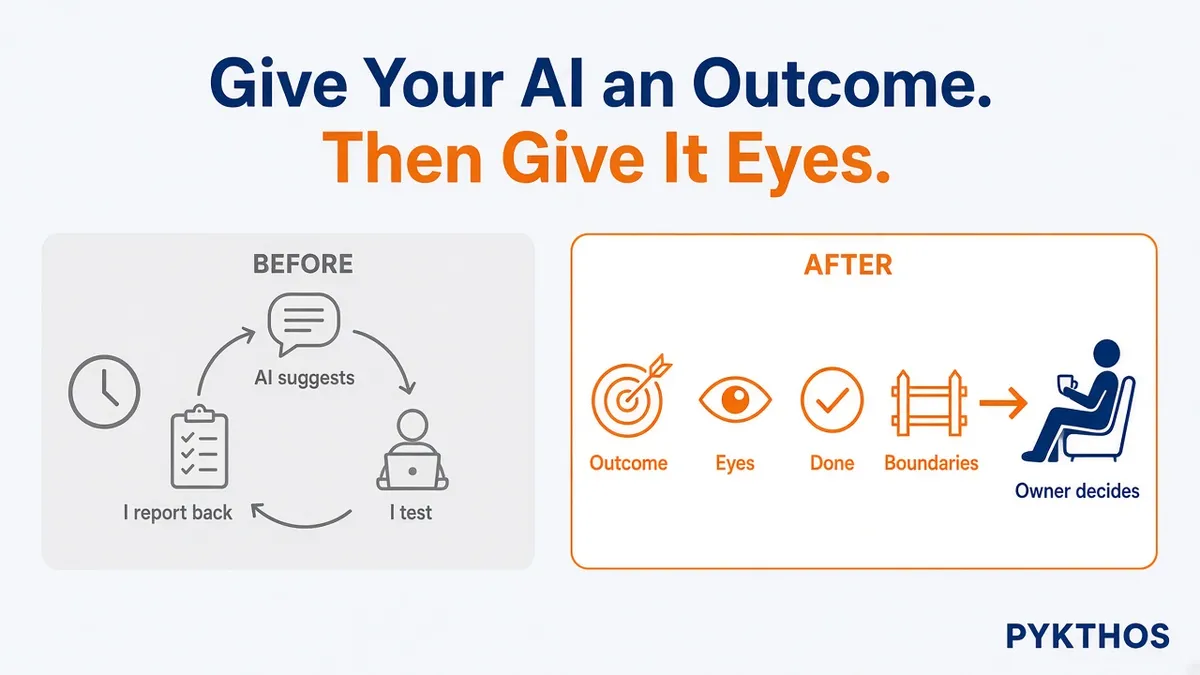
I use Claude, an AI assistant, for a lot of my business. For months, our routine with the chat assistant went like this. I'd notice something odd. I'd ask Claude what might be wrong. Claude would give me a thoughtful list of possible causes and a few tests to run. Then I'd go run the tests myself, come back, describe what I saw, and Claude would interpret my description.
It worked. Sort of. Every round trip cost me twenty minutes, and every time I summarized what I saw, details fell out. I was the bottleneck in my own troubleshooting. I was doing the tedious part while the AI did the interesting part.
Sound familiar? Most practitioners I talk to use AI exactly this way. Ask, get a list, go do the list.
The change
This time I said something different. I asked Claude to go look for itself.
I gave it access to my browser, so it could open the chat assistant's settings and send test questions the way a real visitor would. I gave it read access to the system the assistant runs on. And I gave it an outcome: fix the bot, and prove it's fixed.
Then I stayed in the room, the way you'd stay nearby while a new hire learns the ropes.
What happened next
Within a few minutes it had reproduced the problem. Same question, same "I don't know," three times out of three.
Then it did something I couldn't easily do myself. The chat platform shows which pieces of the knowledge base the assistant pulled before it answered. For that question, it had pulled the entry about people who signed up with the wrong email address. Not pricing. The price was in the knowledge base all along. The assistant went to the wrong shelf, then followed its instruction never to guess.
That finding mattered, because it proved our first guess wrong. We'd assumed the information was missing. If we'd acted on that guess, we'd have rewritten the knowledge base and fixed nothing. Under the old way, a guess like that is exactly what I'd have been handed to go test.
Claude added one line about pricing to the assistant's instructions, saved it, and ran the same test again. Three out of three correct. Then it checked that nothing else had broken.
And it kept going, because when an AI can actually see your systems, it finds things nobody asked about. The biggest one: the signup form for a free course on the Mike Mandel Hypnosis website had been broken for weeks. Anyone who tried to sign up got an error message, and none of us knew. Claude spotted it because visitors had been mentioning it to the chat assistant, so it went to the page, filled in the form itself, and confirmed it was broken. Once I fixed it, Claude signed up again and checked that the confirmation email actually arrived.
Under the old way, I would have gotten a suggestion to "check your forms" somewhere near the bottom of a long list. Maybe I'd have gotten to it that week.
By the end of the night, everything it found was fixed, tested, and written down.
What my job became
During that session, I made the decisions only I could make, like what we say about our Lifetime pricing and what belongs on the sales page. I supplied facts only I knew, like the fact that I'd switched the AI model a few days earlier. I approved anything that couldn't be undone, and I did the one or two clicks I didn't want anyone else making, like deleting an old file.
I didn't run a single test. I didn't summarize a single screen.
That's the shift. I went from being the person who does the checking to being the person who makes the calls. Which is exactly where a business owner should be.
The four parts of giving AI the job
In the Pykthos Mastermind, we teach members to give AI an outcome instead of a list of steps. This session showed me the outcome is only half of it. The full version has four parts:
The outcome. "Fix the bot," not "give me a list of ideas."
Eyes. Access to see the real results, not just to make changes. This is what turns confident guesses into checked answers.
A clear definition of done. Tested, verified, written down. Not "here's what to try."
Boundaries. What it can change on its own, and what waits for you. Ours were simple: back up before every change, keep a way to undo it, and leave anything permanent to me.
Without eyes, you get suggestions. With eyes and boundaries, you get work you can trust.
It wasn't magic. It took some setup, and the AI made mistakes along the way. It caught most of them because it was checking its own work. That's the point.
Why this matters for your practice
You didn't get into coaching or hypnosis to troubleshoot website forms at eleven at night. You got into it to help people. The business side still has to work, though, and for most practitioners that's where the hours disappear.
The answer isn't more tools. It's handing the right jobs to AI in the right way, so the business runs and you stay in your lane.
That's what we work on together in the Pykthos Mastermind. Timothy and I bring what we're building and testing in our own businesses, like this session, and we help members set up the same kind of systems in theirs. Members get ready-made AI assistants they can drop into their own AI tool, a business platform that's already set up for them, and a room full of practitioners working on the same problems.
If you've been using AI as an advice machine and wondering why it isn't saving you more time, it might just be one small shift. You can see everything the Mastermind includes at pykthos.com/mastermind. Have a look. That's not too much to ask, is it?


