



The Hypnotherapist's Q2 Business Playbook: 7 Concrete Actions to Build Your Practice This Quarter
Danielle had everything she needed to launch her six-session hypnotherapy package. She just didn't know it yet.
It wasn't until she sat down and actually inventoried her skills — the master controller protocol, the art gallery technique, the succession framework she'd built after completing her MMHA certification — that the realization hit her: Oh my gosh. I already have this built.
This is one of the most common and most costly mistakes practitioners make: assuming they're further behind than they actually are. The good news? Once you see what you already have, the path forward becomes surprisingly short.
Here are seven concrete, actionable steps drawn directly from what's working for real hypnotherapists and coaches building their practices right now.
Step 1: Do Your Marketing Asset Inventory Before You Build Anything New
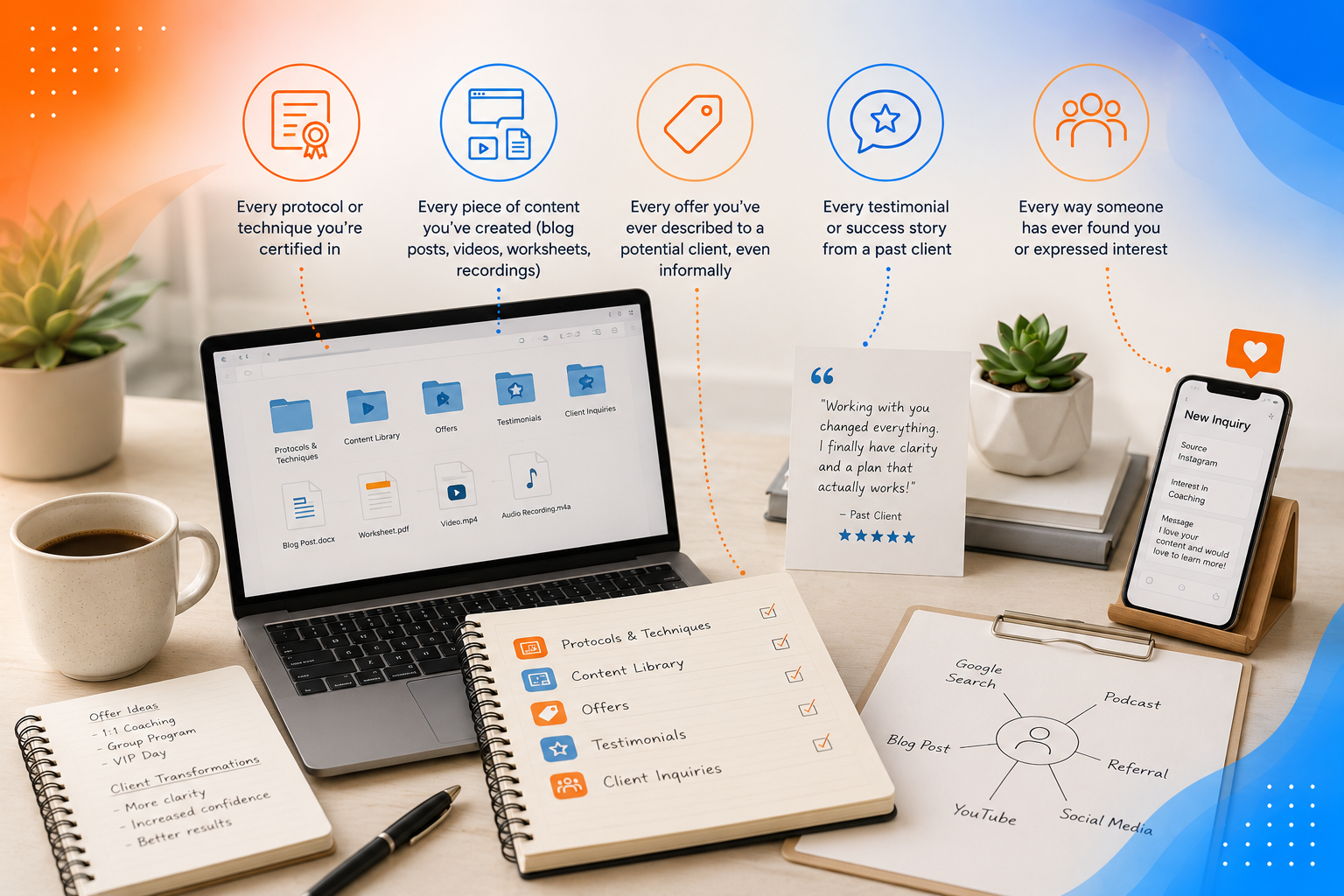
Before you spend a single hour building new content, a new funnel, or a new offer — sit down and write out everything you already have.
This means:
Every protocol or technique you're certified in
Every piece of content you've created (blog posts, videos, worksheets, recordings)
Every offer you've ever described to a potential client, even informally
Every testimonial or success story from a past client
Every way someone has ever found you or expressed interest
Danielle went through this exercise and discovered she'd already built a complete succession package using techniques from her MMHA training. She hadn't recognized it as a sellable offer until she wrote it all down.
You almost certainly have more usable assets than you think.
Step 2: Build Your Core Offer First — The Six-Session Package Model
One of the biggest sticking points for new practitioners is the question: What would I even do in six sessions?
Here's the reframe: you don't need one problem to solve across six sessions. You need six protocols you trust.
Think about the tools in your kit. If you trained with Mike Mandel Hypnosis Academy or a comparable program, you have mindscaping, the art gallery, the master controller, ego state transformation, and a dozen other approaches. Any one of them, run properly with intake and close, is a complete session.
Here's a simple session structure that works:
Intake and goal-setting
Your chosen protocol for the day
Metaphor or integration work to close
Run that with mindscaping in session one. Run it with the master controller in session two. Use the art gallery in session three. You've already built half a package with tools you know cold.
The 8 Wheels of Wellness framework is useful here too — there are eight dimensions of a client's life that generative change work can improve. Even if you solved the presenting problem in session two, there's almost certainly another wheel worth spinning.
Price it at a number that makes the math work. If your goal is five packages a month, and you close roughly one in three discovery calls, you need about fifteen calls a month. Work backward from there to know exactly how many people need to enter your world each month. That's not guesswork — that's a machine.
Step 3: Set Up Your Calendar Automation — And Stop Using Third-Party Tools
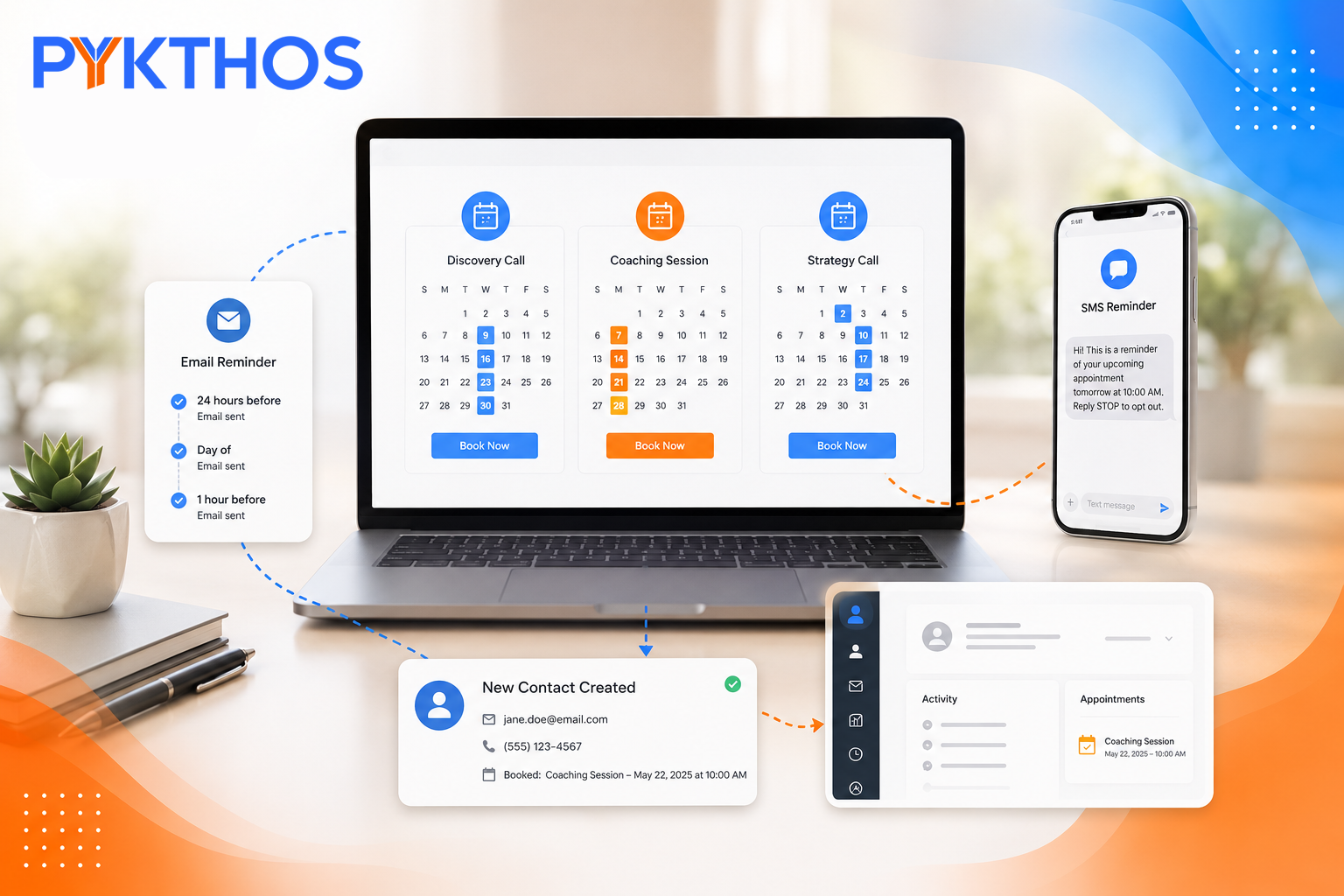
If you're using Calendly, Acuity, or any other standalone scheduling tool while also paying for a full CRM platform, you're paying twice and working in two disconnected systems.
A good all-in-one platform already has everything you need:
Custom appointment calendars for each type of session or call
Automated email reminders sent at intervals you define (24 hours before, day of, etc.)
SMS text reminders once you've connected a dedicated business phone number
Automatic contact creation so every booking flows directly into your CRM
The moment someone books a discovery call through your calendar, the system should be doing four things without you touching anything: confirming the appointment, adding them to your CRM, sending a reminder the day before, and sending a reminder the morning of.
Danielle was planning to set up a separate Calendly account for her discovery calls. She didn't need to — the platform she was already paying for handles all of it, including the automated text and email reminders she wanted. Set this up once. It runs forever.
Step 4: Use the ICE Framework to Stop Drowning in Ideas
Mary said it best during one of our calls: "I feel like I have 100,000 tabs already open."
Every entrepreneur knows this feeling. You get an idea, and instead of parking it, you try to act on it immediately — which means your real priorities never get the focused attention they need.
The ICE Score is a simple triage system:
Impact: How much will this move the needle if it works?
Confidence: How confident are you that it will actually work?
Ease: How easy is it to execute right now?
Score each idea on a scale of 1-10 across all three, add them up, and rank. The highest scores are your Big 3 for the quarter. Everything else goes into an idea parking lot — not deleted, not forgotten, just not now.
The permission to park an idea is itself a relief. You're not saying no to it forever. You're saying: I see you, I'll come back to you in 90 days. That small acknowledgment is often enough to stop the idea from continuing to steal mental bandwidth.
Step 5: Build One Email Workflow to Unify All Your Lead Sources
If you're running a Meetup group, doing in-person talks, seeing private clients, and offering a group program, you probably have people entering your world through four different doors — and you're manually managing four different email streams.
Jane was doing exactly this: duplicating emails across multiple sequences because people came in through different sources. She knew it wasn't sustainable, but her brain power was going toward just getting the emails out, not fixing the underlying system.
This is fixable with one elegant workflow approach: unified tagging into a single long-term nurture sequence.
Here's how it works:
1. Every person who comes into your world — however they find you — gets tagged appropriately at the source
2. Each entry path has its own short indoctrination sequence relevant to how they found you
3. At the end of each specific sequence, they all get tagged with a single universal tag: "long-term-nurture"
4. One workflow, triggered only by that tag, runs a single long-term email sequence to everyone
You write those nurture emails once. Every new contact, regardless of how they entered, eventually flows into the same river. No more duplicating emails. No more managing parallel streams.
Once a week is the minimum nurture frequency. Once a month and people forget who you are.
Step 6: Repurpose Before You Create
Bradley had been running Meetup events on anxiety — a six-cycle program he'd now delivered three times. He was thinking about writing a monthly email newsletter.
Here's a better idea: use what you've already delivered and let AI do the heavy lifting.
If you've recorded your workshops, group sessions, or presentations, the content is already there. The workflow is simple:
1. Run your recording through a transcription tool
2. Upload the transcript to Claude with a prompt like: "Extract 6 weeks of email content from this transcript, one email per week, written in a conversational tone for [your audience]"
3. Edit lightly for your voice and schedule
One hour of presenting yields five to six pieces of usable content. Six Meetup sessions could become six weeks of emails, six weeks of social content, and potentially the foundation of a lead magnet or paid mini-course.
And once a week is far better than once a month — at monthly frequency, people forget who you are before they ever get the chance to trust you.
Step 7: Show Up to Co-Working Sessions Instead of Doing It Alone
The most common point of breakdown in practice-building isn't strategy — it's the moment when you sit down to implement something and hit a wall you can't climb alone.
Jonathan described this perfectly: he was completely stuck on building his funnel because he'd convinced himself he had to use AI for every single step. He'd go to ChatGPT, describe what he wanted, get something wrong, rephrase, try again — in circles for weeks. His brain had just decided it didn't like this and wasn't going to do it.
Then someone on a co-working call showed him something simple: you can just click, drag, and drop elements directly into place. The template is already formatted. You don't have to describe it to an AI and hope. You just build it.
"My brain just unlocked," Jonathan said. "It's so damn fast, much faster than AI."
By the time he got on our group call, he had a funnel nearly complete, testimonials staged, a sales video being scripted, and packages with pricing sketched out. Weeks of perceived blockage, dissolved in a single co-working session.
Don't white-knuckle technical implementation. Co-working sessions exist precisely for the moment when you're stuck. Bring your half-built funnel. Bring your calendar automation questions. Bring the workflow you can't figure out how to connect.
The goal isn't to have everything figured out before you show up. The goal is to show up and leave with one more thing working than when you arrived.
The Bottom Line: You're Closer Than You Think
Danielle already had her offer. Bradley already had a room full of people who'd experienced his work firsthand. Jim woke up at 3:45 AM with a complete framework for his six-session package because his brain had been quietly working the problem in the background.
The practitioners who build the fastest aren't the ones who work the hardest. They're the ones who stop building in isolation, do the asset inventory, pick two or three focused targets for the quarter, and show up consistently to do the work alongside people who can help them when they get stuck.
Now right time to build.
Pick your two. Start the first task. And if you need help with any of the technical pieces — automations, funnels, calendars, or workflows — the Pykthos Mastermind is where we do exactly this, every single week. Join us here and tell us what's your Big 2 this quarter?: https://pykthos.com/mastermind


