



Hypnotists: Why Selling Audios Won't Build Your Business (And What to Do Instead)

If you're a hypnotherapist thinking about selling audio recordings as a way to stop trading time for money, I get it. It sounds perfect. Create it once, sell it forever.
But here's what I've learned the hard way: selling low-priced audios as your main offer is a trap. In this post I'm going to help you understand how to define your real offer (not audios) and show you how to incorporate those audios into the customer journey in a way that actually works.
The $37 Lesson That Took Me Years to Learn

Back in 2008, I created a program called Talking to Toddlers. It was an audio program teaching parents hypnotic language patterns to handle meltdowns. Embedded commands, presuppositions, distraction techniques. Good stuff.
I sold it for $37.
And for a while, it worked. I had some SEO luck and this business actually hit a $100,000 a year run rate. Sounds great, right?
Here's the problem: that didn't last. Google's ranking algorithm changed, and my site all but disappeared in the search rankings. If you're planning to copy that model, it's not going to do much for your wallet unless you're selling many copies per day. And that won't happen without a hell of a lot of organic traffic. Paid ads are out of the question because you'll find it nearly impossible to be profitable making sales at $37 a pop.
I eventually shut that business down. Not because it failed, but because I had no real core offer behind it. There was nowhere for customers to go next. It was a dead end, not a doorway.
At the time, I was also having a lot more fun building Mike Mandel Hypnosis, which had a real path for students to follow. And honestly? I didn't know much about marketing back then. I didn't know what I'm about to share with you.
The Conversation That Changed Everything

On a recent Strategy Cafe call, a practitioner named Vicki said she wanted to sell recordings so she wasn't exchanging time for money.
My Pykthos co-founder Timothy September read her question aloud: "Wondering how to sell things like recordings so I'm not exchanging time for money. Marketing and social media isn't gaining much traction."
Timothy pointed out that this desire to stop trading time for money is a great instinct. A lot of us got started with that paradigm shift from Tim Ferriss' 4-Hour Workweek. The idea that you need to stop being the gear that moves everything.
But I wanted to dig deeper. So I asked Vicki a question.
"When you say selling recordings, is that your core offer? The thing that's actually going to make you money? Or is the real offer something else, like group coaching or one-on-one work?"
Her answer: "The real offer would be group."
And that changed everything.
See, Vicki didn't have a product problem. She had a strategy problem. She was thinking about what she could sell, when she should have been thinking about what her business actually is and then working backwards from there.
Your Hypnosis Audio Track Isn't a Business. It's the Door.

Here's the shift.
Your group program, or whatever your core offer is, is how you make money. That's the thing that actually pays your bills and changes lives.
Your audio? That's how you get people in the door.
It's either a lead magnet, something free you give away in exchange for an email address, or a low-priced tripwire, something under $10, maybe bundled with bonuses to make it feel like a steal.
Either way, its job isn't to make you rich. Its job is to turn a stranger into a prospect, or turn a prospect into a customer.
This matters because of something one of our community members, Tai, called "heteroaction for business." In hypnosis, we know that once someone accepts one suggestion, they're more likely to accept the next. It's called heteroaction, and the same thing applies here. Once someone buys from you, even something small, a psychological shift happens. They stop seeing themselves as a subscriber and start seeing themselves as a customer.
Customers open your emails. Customers pay attention to your offers. Customers trust you more. And customers are far more likely to buy your core offer when you eventually present it.
I gave Vicki the example of our language cards at Mike Mandel Hypnosis. They're technically free. People just pay for shipping. But the moment someone buys them, they become a customer of ours. They're more likely to log in, more likely to consume our content, more likely to take our follow-up messages seriously. Because now they identify as a customer, not just someone on an email list.
The Problem With Competing on Audios
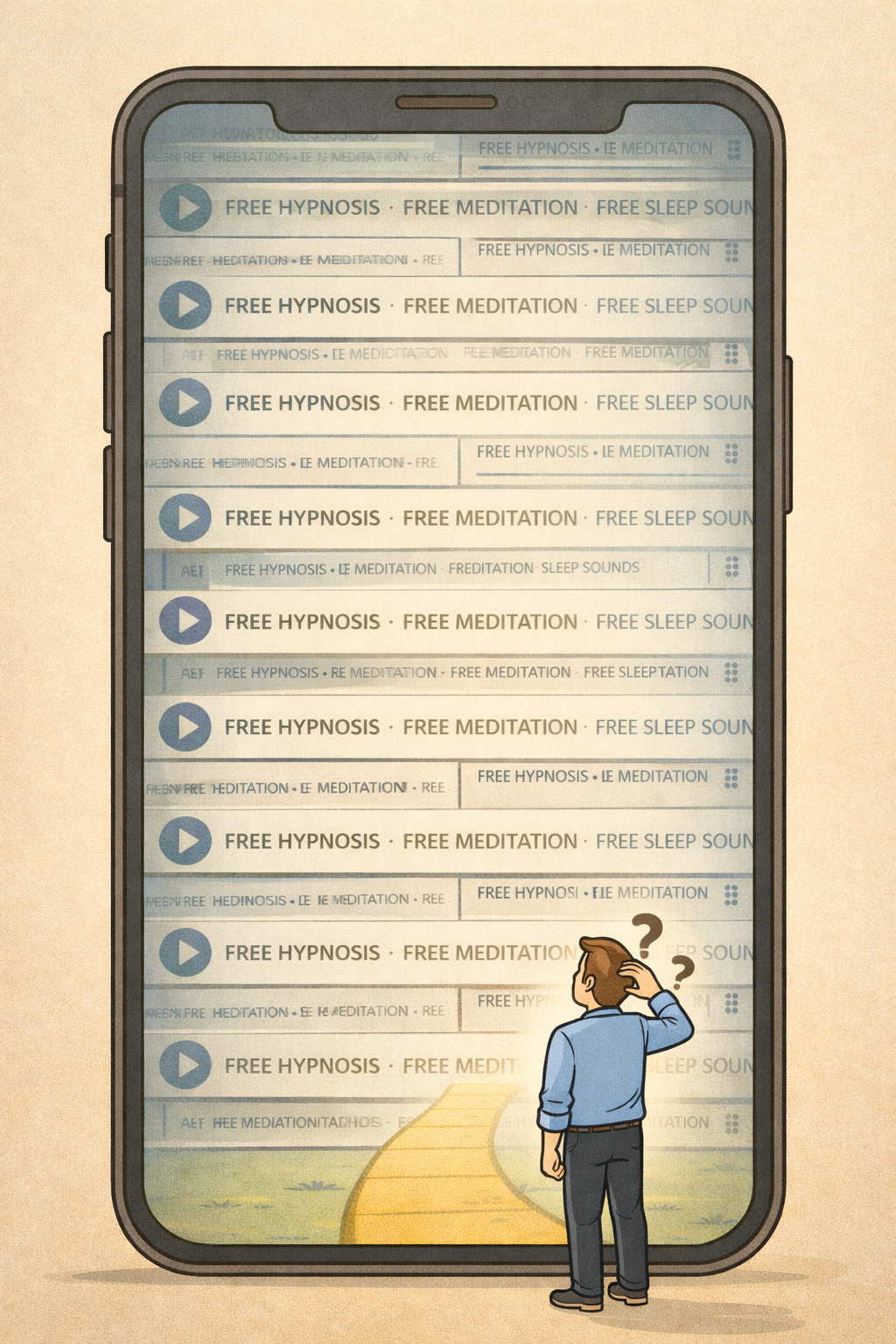
Here's the other issue with selling audios as your main thing: the market is flooded.
Go to Spotify. YouTube. Apple Music. Search for "hypnosis for anxiety" or "sleep hypnosis" or whatever your niche is. You'll find thousands of free options.
So how do you compete with free? You don't. Not on the audio itself.
You compete by speaking directly to your customer's specific problem, not generic relaxation but their actual pain point. You compete by positioning the audio as the first step in a journey with you. You compete by bundling it with enough value that the price feels like a no-brainer. And you compete by nurturing them toward your real offer.
This is where understanding the 5 levels of customer awareness becomes essential. Most practitioners try to sell to people who are already solution-aware or product-aware. But the biggest opportunity is often with problem-aware prospects, people who know they have a problem but haven't yet figured out how to solve it. Your audio can be the thing that meets them right there.
The audio gets them in. Your emails build the relationship. Your group program is where the transformation, and the revenue, actually happens.
Start With the End in Mind

Most practitioners think forwards. I'll make an audio, sell it, and hopefully people will buy more stuff later.
Flip it. Think backwards. Start with your core offer, then ask yourself what needs to happen before someone is ready to buy it. What trust needs to be built? What problem can you begin to solve? The audio becomes the thing that starts that relationship.
When you design backwards from your core offer, everything else clicks into place. The audio isn't some random product you're hoping will sell. It's a strategic piece of a larger system that leads people toward working with you in a deeper way.
What to Do Next
If you're sitting on audio content, or thinking about creating some, ask yourself three questions.
First, what's my actual core offer? The thing that pays the bills and delivers real transformation?
Second, what problem does my ideal client have that my audio could begin to solve?
And third, how do I position this audio as the first step, not the final destination?
Get clear on that, and your audio stops being a product that doesn't sell. It becomes a client-getting machine that feeds your real business.
Join Us Live

This insight came from a real conversation on our free Strategy Cafe call. Every other Friday, Timothy and I help practitioners get unstuck on exactly this kind of stuff. No slides, no pitch, just real conversation and problem-solving.
Register for the next one at pykthos.com/cafe.
And if you want help building the systems that turn strangers into leads into customers, that's what we do inside the Pykthos Mastermind.


