




The 5 Levels of Customer Awareness (And Why You're Probably Marketing to the Wrong One)
If you've ever stared at a blank screen wondering what the hell to post, you're not alone.

Most coaches, therapists, and hypnotists struggle with content creation. Not because they're bad at it — but because nobody taught them who they should be talking to.
And no, the answer isn't "my ideal client." That's too vague to be useful.
The real answer comes from a guy named Eugene Schwartz, who wrote a book called Breakthrough Advertising back in 1966. It's considered one of the greatest marketing books ever written. It's also nearly impossible to buy — used copies go for $500-$700 on Amazon. So unless you're willing to sell a kidney or your firstborn child, you're probably not getting your hands on it.
Good news: we'll give you the part that matters most right here.
The 5 Levels of Awareness
Schwartz figured out that your potential customers aren't all in the same mental place. Some people are ready to buy right now. Others don't even know they have a problem yet. And the way you talk to each group is completely different.

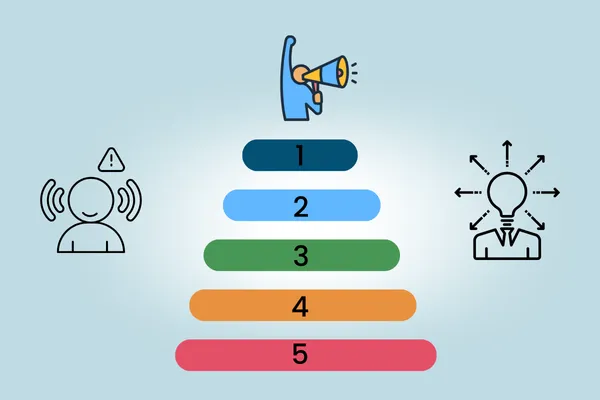
He broke it down into five levels:
Level 1 — Unaware. These people don't know they have a problem. They're not looking for help. They're not thinking about change. Trying to market to them is like trying to sell an umbrella to someone who doesn't believe in rain. Skip them.
Level 2 — Problem Aware. They know something's off. They feel stuck, anxious, frustrated, or unfulfilled — but they haven't started looking for solutions yet. They're not Googling "therapist near me." They're lying in bed at 2am thinking, "Why can't I just get my shit together?"
Level 3 — Solution Aware. Now they're actively researching. They've decided to do something about the problem, and they're exploring options. Therapy? Coaching? An app? A course? They're comparing.
Level 4 — Product Aware. They know about your type of solution. Maybe they've heard of hypnotherapy or mindset coaching. They're just not sure if your approach is the right one for them.
Level 5 — Most Aware. They know exactly what they want. They've done the research, they're sold on the method, and they just need the right offer to say yes.
Why Most Practitioners Market to the Wrong Level
Here's where it gets interesting.
Most coaches and therapists focus their marketing on Level 3 — Solution Aware. They write content like "5 Reasons to Try Hypnotherapy" or run ads targeting people searching for "life coach near me."
Makes sense, right? Those people are actively looking.
The problem is, everyone is competing for that audience. Every hypnotist in your city is bidding on the same Google keywords. Every coach is trying to rank for the same search terms. It's crowded, expensive, and loud.
Meanwhile, Level 2 is wide open.
The Case for Problem Aware
People at Level 2 aren't searching for you yet — but they're in pain. They're scrolling social media at night, feeling stuck, wondering why they can't just do the thing they know they need to do.
They're not looking for a hypnotist. They're looking for someone who gets it.
And that's your opening.
If you can articulate their problem better than they can articulate it themselves, you will own their attention. They'll stop scrolling. They'll feel seen. And they'll pay attention to whatever you say next.
This is the sweet spot. The audience is bigger, the competition is lower, and the connection you create is stronger — because you're not pitching, you're resonating.
The Problem Statement Formula

So how do you actually create content for Problem Aware people?
Start with what we call problem statements. These are short phrases that describe the inner experience of your ideal client — in their words, not yours.
The formula is simple. Finish one of these sentences:
"I wish..."
"I need..."
"I want..."
From your client's perspective. Not what you think they should want. What they actually say when they're frustrated, stuck, or struggling.
Here are some examples:
I wish I could just stop overthinking everything.
I need this anxiety to stop running my life.
I want to stop sabotaging myself right before I succeed.
I wish I knew why I can't just do the thing I know I need to do.
These aren't clever taglines. They're not polished marketing copy. They're the raw, honest thoughts your clients are already having.
And that's what makes them powerful.
Where Do You Find These?
Don't make them up. Mine them from real conversations.
Go back through your discovery calls, intake forms, and emails. Look for the exact phrases people used to describe their struggles. Not your clinical summary of their problem — their actual words.
"I feel like I'm stuck in quicksand." "I know what I should do, I just can't make myself do it." "It's like there's two versions of me and they're fighting all the time."
Write those down. Every single one. That's your content goldmine.
Once you've got a list from your own experience, you can expand it with AI. Give ChatGPT your ideal client profile and ask it to generate 10 more complaints starting with "I wish" or "I need" — in the client's voice. But always start with your real data. AI is a good expander, not a good inventor.
How to Talk About Pain Without Being Sleazy
Now, some of you are already uncomfortable.
"I don't want to poke at people's pain. That feels manipulative."
We hear this a lot, especially from therapists and healers. And it's a valid concern. You didn't get into this work to be a used car salesman.
Here's the thing: naming someone's problem isn't manipulation. It's connection. It's what good therapists do in session — reflect back what you're hearing so the client feels understood.
But if directly stating the problem feels too confrontational for your content, use the quotes technique.
Instead of saying: "Are you stuck in a cycle of self-sabotage?"
Say: "I work in a field where clients often say to me, 'I know exactly what I need to do — so why can't I just do it?'"
Same message. But now you're telling a story about what clients say, not putting your audience on the spot. It's a layer of dissociation that lets people recognize themselves without feeling called out.
You can also use phrases like:
"A question I get asked a lot is..."
"One thing I hear all the time is..."
"Something that comes up in almost every session..."
This lets you articulate the problem clearly while keeping the tone warm instead of confrontational.
Using Metaphor to Widen (or Narrow) Your Net

Here's another tool: metaphor.
Metaphors let you describe a feeling without naming a specific problem. Watch what happens with this phrase:
"Do you feel like you're carrying a weight on your shoulders?"
That could apply to almost anyone — work stress, relationship problems, health issues, grief, parenting, anything. It's broad. A lot of people will nod.
Now add one word:
"Do you feel like you're carrying a weight on your shoulders... at work?"
Suddenly you've narrowed the audience. People dealing with work stress lean in. Everyone else tunes out.
This is useful because you can adjust how targeted your content is just by how specific you get with the metaphor.
Broad metaphor = wider reach, more engagement, good for top-of-funnel content. Specific metaphor = narrower reach, stronger resonance, good for speaking directly to your niche.
Play with this. A phrase like "Do you feel trapped in a cage?" is universal. Add "...in your relationship" or "...by your own habits" and it becomes pointed.
Now You're Never Stuck for Content Ideas
Let's put this all together.
You've got a formula for generating problem statements. You've got a source for finding them — your real client conversations. You've got a technique for talking about pain without being sleazy. You've got metaphor as a dial to widen or narrow your message.
That's not just one content idea. That's an engine for producing them.
Take one problem statement. Post it as a simple graphic with "Does this resonate?" and see what happens. Turn another one into a 60-second video: state the problem, validate it, offer one small reframe or tip. Write a newsletter that opens with a metaphor and ends with an invitation to reply.
Test which ones hit. The posts that get comments, shares, and DMs? Those are your winners. Build more content around those themes.
You'll never stare at a blank screen again — because you're not trying to invent ideas from nothing. You're just listening to what your people are already saying and reflecting it back to them.
That's not marketing. That's rapport.
And it works.
Want Help Implementing This?
This is the kind of thing we dig into every week inside the Pykthos Mastermind — the business growth community built specifically for coaches, therapists, and hypnotists who want to get better at attracting clients without feeling like a sleazy marketer.
You get live calls with hands-on coaching, a community of practitioners who are actually implementing (not just consuming), and access to all the digital tools you need to run your practice — CRM, email marketing, landing pages, booking calendars, and more. All included.
The best part? Membership costs less than what most people pay just for inferior tools.
If you're tired of trying to figure this stuff out by yourself, come join us.


