



How to Describe What You Do So the Right Client Says “That’s Me”
If you want the right client to read your post and think "that's me," stop describing her with a label and start describing her with her own words. Not "midlife women who don't make time for themselves," but the thing she says to herself when she can't sleep. Then tell her what she'd actually get, in terms she can picture, like a number on the bar or her weekends back. That's the whole method. The rest of this post shows how it works, using real questions from the free Strategy Café and our coaching calls, with Chris Thompson and Timothy September.
Why doesn't "I help midlife women who don't have time for themselves" get anyone to reach out?
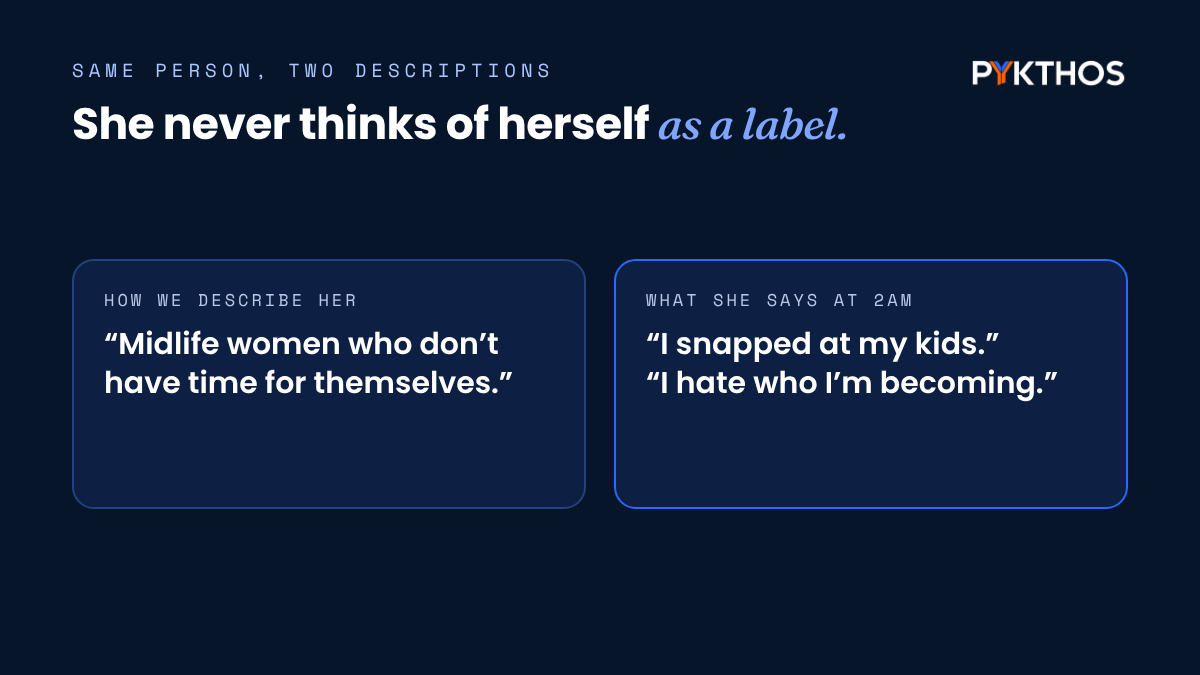
Because nobody thinks of herself that way. A practitioner recently emailed a question into the Strategy Café. Her ideal client was midlife women who don't make time for themselves, and her main problem was getting those women to find her and book her.
Chris's answer was that the description is a good start, but it describes a category, not a person:
"...nobody usually wakes up thinking, Well, I'm this middle life woman. I don't have time for myself. They usually lie awake in the middle of the night, and they'll say stuff like, Man, I just I snapped at my kids. I hate who I'm becoming."
A demographic tells you who to aim at. It doesn't tell her that you understand her. She doesn't scroll past your post because she's the wrong age. She scrolls past because nothing in it sounds like the inside of her own head.
What does "the dog whistle" mean?
Chris borrows the phrase from his friend Laurel. Your content should act as "a dog whistle for their problems. So, the dog whistle means you blow the dog whistle, only the dogs can hear it, only they respond to it."
In practice, the first two or three sentences of a post or video name a problem so specifically that only your person hears it. Everyone else keeps scrolling, and that's fine. The one who stops is thinking, as Chris put it, "Oh, she's talking to me."
Timothy showed what that sounds like with the same midlife example. Instead of opening with "I help midlife women who just don't have time for themselves," he offered this as a hook:
"Have you ever lied awake at night thinking about all the times that you snapped at your children just today, and you realize that this version of yourself is who you've hated the most?"
Same woman. Same service. One version is a label she'd nod at politely. The other is a sentence she may have actually thought at 2am last Tuesday.
How do I find the words she says to herself?
You already hear them. They come up in the first few minutes of a session, in the messages people send before they book, and in the way clients describe their week when you ask how it's going. The work is to write them down exactly as they're said, instead of translating them into your professional vocabulary.
A few questions that help:
- What does she say to herself when she can't sleep?
- What did she do this week that she's embarrassed about?
- What would she never say at a dinner party, but tells you in the first session?
- What has she already tried, and what does she say about why it didn't work?
If you'd rather work it through on paper, the free Perfect Client Snapshot walks you through her current reality, the story she tells herself, and the conflict that keeps her stuck.
How do I describe a result that's hard to put into words?
This is the other half of the problem, and it trips up a lot of coaches and hypnotists. The work is real, but the results sound vague: more freedom, less stress, feeling unstuck, moving forward. It's one of the most common sticking points we hear: the tools work, but it's hard to describe the result in a way that makes someone think, yes, I want that.
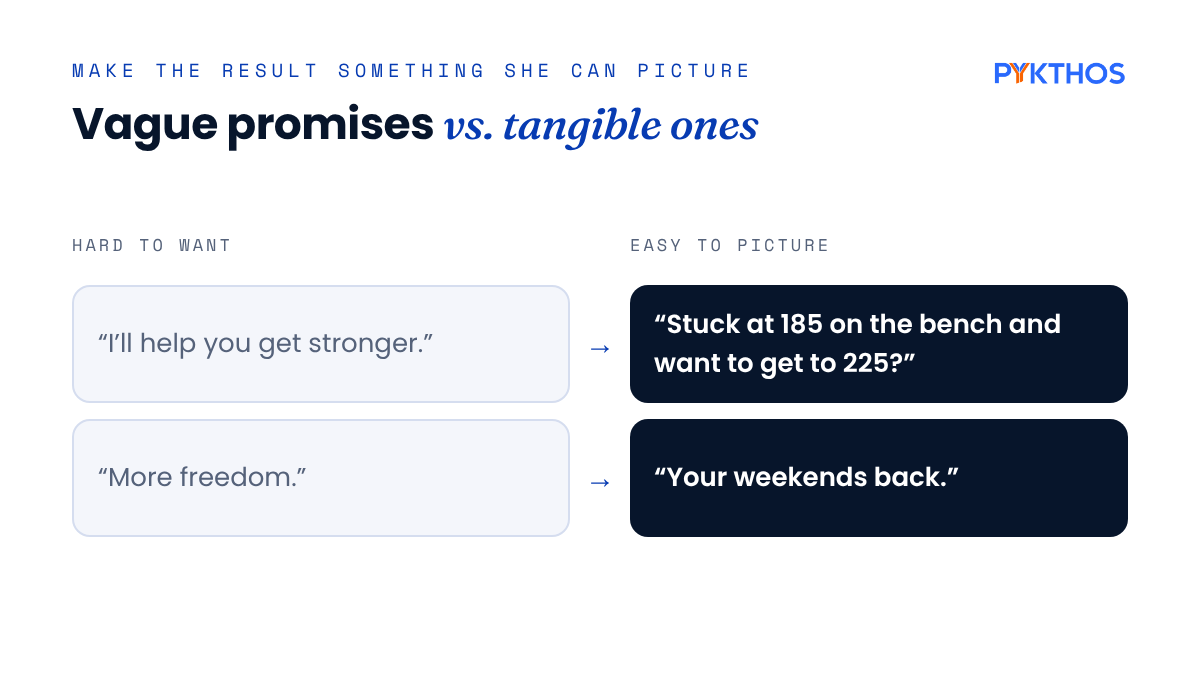
Timothy's answer, in short: if you tell someone that in three months they'll have more freedom and be more successful, they won't care. Then he showed the alternative:
"...what if you got all of your weekends back, so you can play with your kids? ... Or what if you were able to finally make that mortgage payment...?"
What changed? In his words, he "turned the intangible, which are nominalizations, unspecified verbs, that kind of hypnotic language, into something tangible, which is stuff that the person can actually imagine."
Hypnotists will recognize those terms. Vague language works well in a session because the client fills in their own meaning. In a description of your offer it works against you, because there's nothing for the reader to picture.
What does "make it tangible" actually look like?
Timothy used a gym example on the same call:
"But you wouldn't say, I'll help you get stronger, and you'll get faster and more powerful. You'd say, are you stuck at 185 in your bench, and you want to get to 225?"
Nobody has to explain "185 to 225" to someone who lifts. They either are that person or they aren't. It's the same dog whistle, aimed at the result instead of the problem.
To do this with your own work, take each fuzzy word in your offer and ask, "What would that look like on an ordinary Tuesday?" Less stress might mean sleeping through the night. Confidence might mean saying your price without laughing. Being present might mean eating dinner with the kids instead of answering email. Pick the version your client would actually say.
The free Offer Builder Worksheet helps you turn that into one sentence a stranger could repeat back to you.
Why does AI give me generic messaging?
Because it was given a generic description. At the same Café, someone asked why the content plans an AI tool gave them weren't working. Chris's first question back was:
"have you created your ideal client avatar, your content bible, your… a few of the other foundational documents we recommend?"
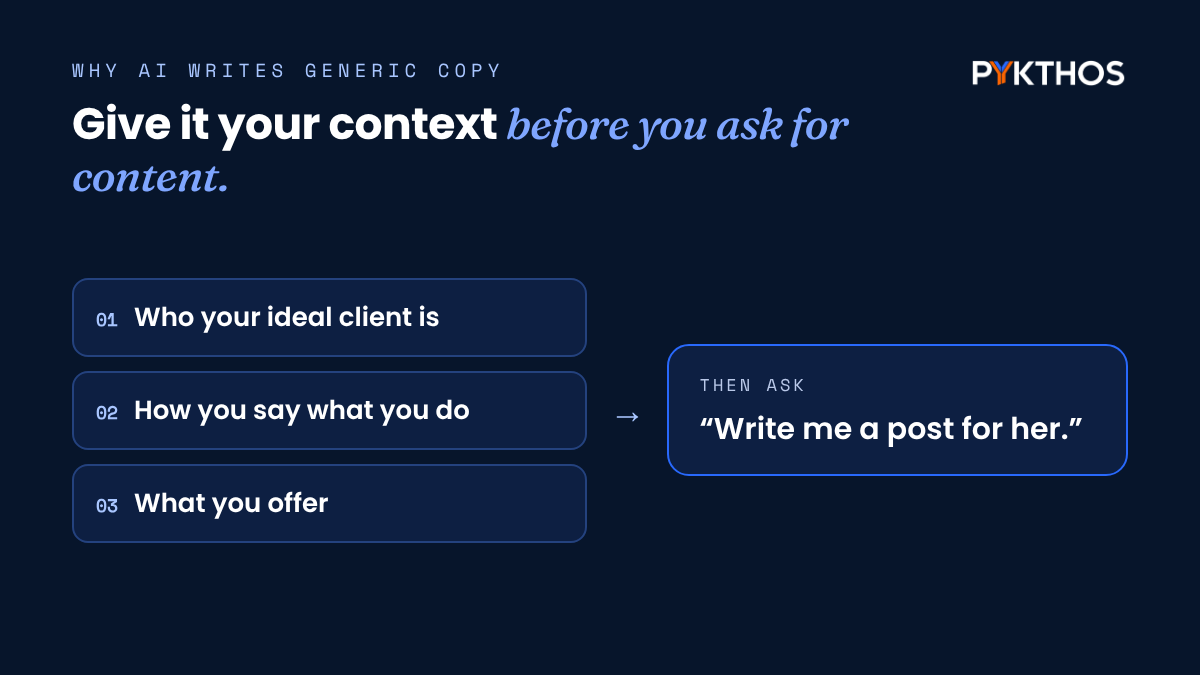
If you type something like "Hi, I'm a hypnotherapist… I want more clients. Help me plan some YouTube videos," you get the average answer for every hypnotherapist on earth. If you give it your ideal client, her exact words and her problems first, you're, in Chris's words, "training it ahead of time. You're saying, hey, Claude, these are my people, and these are the dog whistles, these are the things that I need to say that are going to resonate with those people."
AI is good at turning your notes into drafts. It can't make up the sentence your client says to herself in the middle of the night. That comes from you listening, and then writing it down. As Chris said, "AI should be used everywhere in your business that you can let it. Not replace the actual human touch."
So what do I actually write next?
Keep it simple:
- Write down three things your client says to herself when she can't sleep.
- Open your next post or video with one of them.
- Name one result she can picture, in numbers or in a scene from her week.
- Give her one small next step, like a short guide or audio she can ask you for. Timothy's advice: "Just give them one task."
Then pay attention to who replies. Those replies are where your next batch of her words comes from.
Should I offer a free session to attract clients?
You can, but it doesn't have to be a full session. Timothy's suggestion was to pick one problem your client has and create something small that helps with it, like a hypnosis audio, a PDF or a short explainer guide. Something that "helps them solve one tiny problem that just gets that first step going, gets that conversation going."
What if I don't know who she is yet?
Start there. Chris's advice was to "figure out who is your market, what is your ideal client look like?" before making content for her. The free Niche Clarity Worksheet is a good first pass.
How long should the "dog whistle" part be?
Short. Chris described it as the "first opening two, three sentences." If she recognizes herself there, she'll read the rest.
Want help with your own line?
Bring the one line you use to describe what you do to the Strategy Café, the free live group call Chris and Timothy run on Zoom every other Friday at 11am Eastern. They answer as many questions as they can, live. Camera on or off, your call.


