



From Stranger to Raving Fan: The 8-Stage Customer Value Journey Every Hypnotist and Coach Needs to Build Right Now
Imagine you walk into a coffee shop. Across the room, you notice someone who catches your eye. You think, wow, that person is attractive. But instead of walking over and introducing yourself, you immediately sprint across the room, grab their hand, and say, "Hi, will you marry me?"
That's exactly what most independent practitioners do with their marketing.
They post on social media, and the CTA is immediately "Book a session." They hand out business cards at a networking event and expect a phone call the next day. They run a Facebook ad directly to their highest-ticket offer and wonder why nobody's clicking.
The problem isn't your product. The problem isn't your price. The problem is that you're skipping every stage of the relationship and going straight to the proposal.
What you need is a customer value journey — and more importantly, a way to automate it so it runs even when you're sleeping.
What Is the Customer Value Journey?

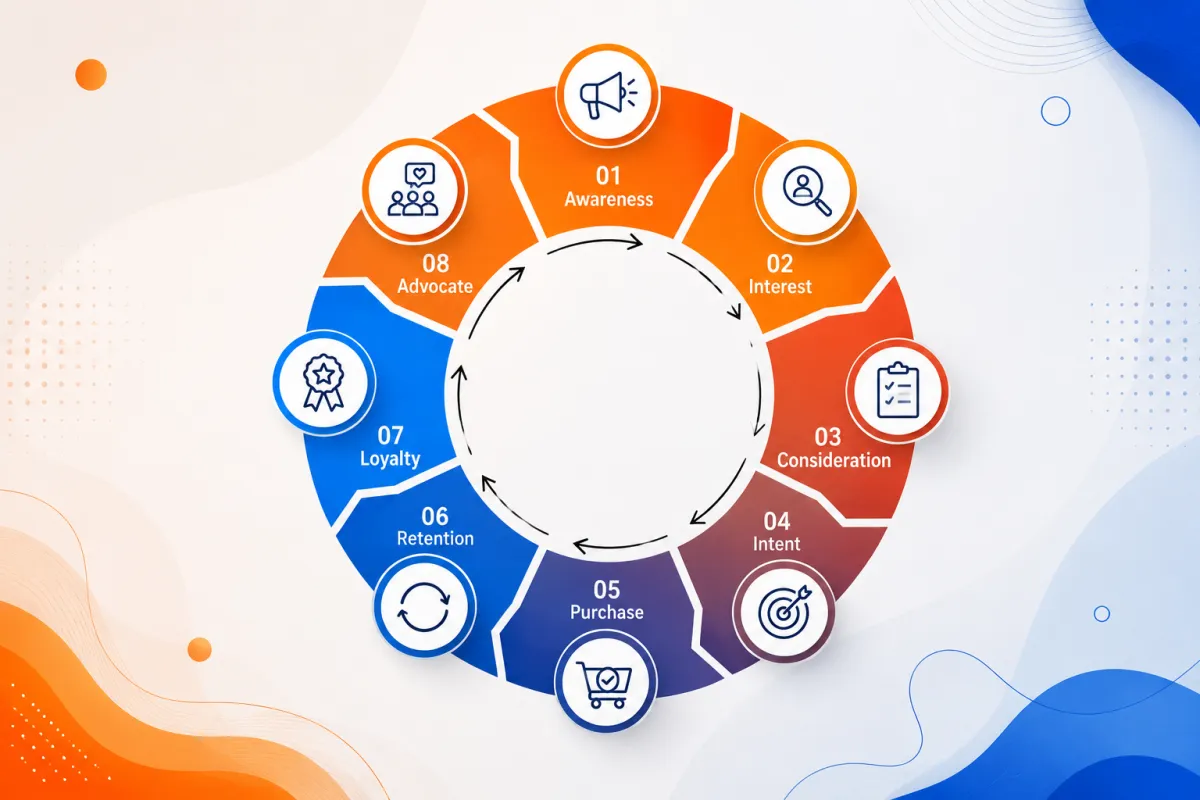
The customer value journey is a marketing map. It's a framework that answers the most important question in your business: how do strangers become buyers?
You may have heard of the 4-7-11 rule — the idea that a prospect needs roughly 11 touchpoints across different locations and types of media before they're ready to buy. The customer value journey is the system that delivers those touchpoints in a logical, intentional sequence.
This framework comes from Ryan Dice and the team at Digital Marketer, and it's been the backbone of virtually every successful online business for years. But most independent practitioners have never applied it to their own work in a systematic way.
Let's walk through each stage.
Stage 1: Awareness — The Glance Across the Room
Awareness is simply the moment someone learns you exist. Nothing more, nothing less.
Using our coffee shop analogy: awareness is the moment you glance across the room and notice someone. It's a friend mentioning your name in conversation. It's a potential client scrolling and your post appearing in their feed for the first time. It's a Google search result with your name in it.
At this stage, you're not asking for anything. You're simply becoming visible to people who have the problem you solve.
Practical application: Social media content, blog posts, podcast appearances, Google Ads for brand awareness, word-of-mouth referrals — all of these are awareness-stage activities.
Stage 2: Engagement — The Introduction
Engagement is when someone takes a first small action that signals interest. In our coffee shop analogy, this is you walking over and saying hello.
Online, engagement looks like: a like on your post, a comment on your video, a share of your content, clicking on your ad, or following your page. It's the first micro-commitment a prospect makes — and it signals that the awareness worked. They saw you. They found you interesting enough to do something.
Practical application: Create content that invites engagement — ask questions in your posts, use polls, create content that people want to comment on or share. Don't just broadcast; create conversations.
Stage 3: Subscription — The Exchange of Value
This is where the relationship becomes real: they give you their contact information in exchange for something valuable. This is your lead magnet.
And here's where I need to challenge something most practitioners get wrong: more is not better when it comes to lead magnets.
I know the instinct is to over-deliver. You want to give away a 45-minute hypnosis audio because you want people to experience the full depth of what you offer. But here's the hard truth: without consumption, there is no conversion.
If someone downloads your audio and never listens to it, it might as well not exist. That's the same as buying a book and putting it on your shelf and never reading it. And the longer the content, the lower the consumption rate. The sweet spot for a lead magnet is 10 minutes or less — something so fast and easy to digest that your prospect actually completes it.
Good lead magnet ideas:
A single-page checklist
A one-page cheat sheet outlining your framework
A 5-to-10-minute hypnosis audio (a quick mental reset, a stress stabilizer)
A short step-by-step process document
The goal isn't to give them everything. The goal is to give them one specific, quickly-consumed win that makes them think: "If this is what they give away for free, imagine what the paid stuff is like."
Stage 4: Conversion — The First Commitment

A conversion qualifier is either a time commitment or a low-dollar transaction — and it's one of the most psychologically important moments in the entire journey.
Here's why: the mindset of someone willing to invest — even $7 — is fundamentally different from the mindset of someone who only takes free things. When someone pays even a tiny amount for something, their brain categorizes them as a buyer. And buyers buy again.
Laurel Portier's $7 ads coaching program at adcoachingfor7.com is a perfect example of this in action. That $7 price point isn't about revenue — it's about psychological transformation. She's converting a prospect into a buyer, and once someone is a buyer, everything changes.
For service-based practitioners, the conversion stage often looks like a discovery call — a free but time-committed touchpoint where the prospect invests their most precious resource (time) to explore working with you.
Key insight: This is also where Laurel's concept of the content bible becomes essential. Your content bible is a comprehensive document about your offer, your process, and your client journey — so thorough that if someone asked you any question on a sales call, the answer is already in that document. It drives the copy and messaging you use when building your ads and your funnels.
Stage 5: Excitement — The Aha Moment
This is the moment your new client (or prospect) thinks: "Oh my god, THAT'S what I've been looking for."
For hypnosis and coaching practitioners, this often happens during a discovery call when you do a brief demonstration — maybe a quick NLP pattern or a short induction — and the person on the other end of the call experiences something they didn't think was possible.
That moment of "wait, this actually works?" is the excitement stage. And it's your job to engineer it intentionally, not leave it to chance.
Practical application: Build a specific aha moment into every discovery call. Know exactly what demonstration, story, or insight will reliably produce that shift in your prospects. Then deliver it consistently.
Stage 6: Ascension — The Core Offer
Once the aha moment has happened, your prospect is primed to buy. This is where you present your core offer — and this is also where many practitioners fumble spectacularly.
The client says, "I'm ready, what's the investment?" And the practitioner stammers, "Uh... maybe $100? I don't know, we'll see how it goes?"
That hesitation kills the sale every single time. Confidence and congruence in your offer are non-negotiable. You need to know exactly what you're selling, exactly what it costs, exactly how it works, and exactly why it's worth every cent — before you ever get on that discovery call.
This is why going through the exercise of articulating your offer, your audience, and your outcomes with real precision matters so much. That clarity is what lets you sell confidently when the moment arrives.
Stage 7: Promotion — The Activated Fan
A client who got extraordinary results doesn't just come back. They tell people.
This is the promotion stage — and in the hypnosis and coaching world, it's arguably your most powerful marketing channel. Practitioners who have walked their clients through a complete, well-structured journey produce clients who are enthusiastic advocates. They give testimonials. They refer friends. They post about their results publicly.
Practical application: Don't leave this to chance. Build a follow-up sequence that asks for testimonials and referrals at the right moment — right after your client has experienced their biggest win.
Stage 8: Advocate — The Flywheel
Advocates are your unpaid sales force. These are the people who've been through your entire journey, gotten remarkable results, and now actively bring you new business simply because they can't stop talking about you.
When you have advocates, your customer value journey becomes a flywheel — each rotation generates more momentum than the last, bringing in new awareness-stage prospects who eventually become advocates themselves.
The Simple Machine: Automating the Entire Journey

Here's the challenge: executing all 8 stages consistently, for every prospect, without burning yourself out is impossible to do manually.
That's why we built what we call the Simple Machine inside the Pythos Mastermind.
The Simple Machine is a pre-built collection of all the assets and automations that handle this entire journey — so that once it's set up, a stranger can enter at the awareness stage and move through every touchpoint to become a buyer (and eventually an advocate) with minimal manual intervention from you.
Here's what a properly built Simple Machine includes:
A lead magnet funnel with a landing page, thank-you page, and automated delivery sequence
A booking system with automated confirmation and reminder emails
A nurture email sequence that builds trust and moves leads toward the discovery call
A core offer funnel with best-practice copy and upsell pathways
Automations and tagging so you always know where every contact is in your journey
A post-client follow-up sequence that captures testimonials and activates advocates
The critical difference between a website and a funnel bears mentioning here: a website is a hub — people can wander anywhere. A funnel is a linear, step-by-step path with one job: move this person to the next stage. You need both, and they serve different purposes.
Your website should point to your funnels. Your social media bio link should point to your funnels. Your ads should point to your funnels. Everything points toward the machine.
Think of it like the difference between Barnes & Noble's homepage — endless options, no single path — and a product landing page built to sell one specific thing: one path, one decision, one outcome.
The Congruence Test: Does Your Journey Make Sense?
Here's a quick gut-check for your current marketing. Imagine a mechanic finishes your oil change and then asks, "Would you like to buy two oranges for a dollar?"
Nonsense, right? But that's exactly what happens when a practitioner delivers a hypnosis audio about anxiety and then immediately offers something completely unrelated with no bridge between them.
Every stage of your customer value journey needs to flow naturally from the previous one. The lead magnet should logically lead to the discovery call offer. The discovery call should naturally lead to the core offer. The core offer should produce results that make the testimonial and referral request feel obvious.
Congruence at every stage is what makes the whole machine run.
Start Building Today

You don't need to build all 8 stages overnight. Start with one: build a strong lead magnet that someone can consume in 10 minutes or less, put it behind a simple landing page, and set up one automated email that delivers it and invites a discovery call.
That's your first gear turning. Everything else builds from there.
Join us live at pykthos.com/cafe every other Friday for free strategy sessions where we break down exactly how to build and optimize each stage of this journey. Bring your questions — real answers happen in the room.
The journey from stranger to raving fan doesn't happen by accident. Build the machine, and let it run.


