




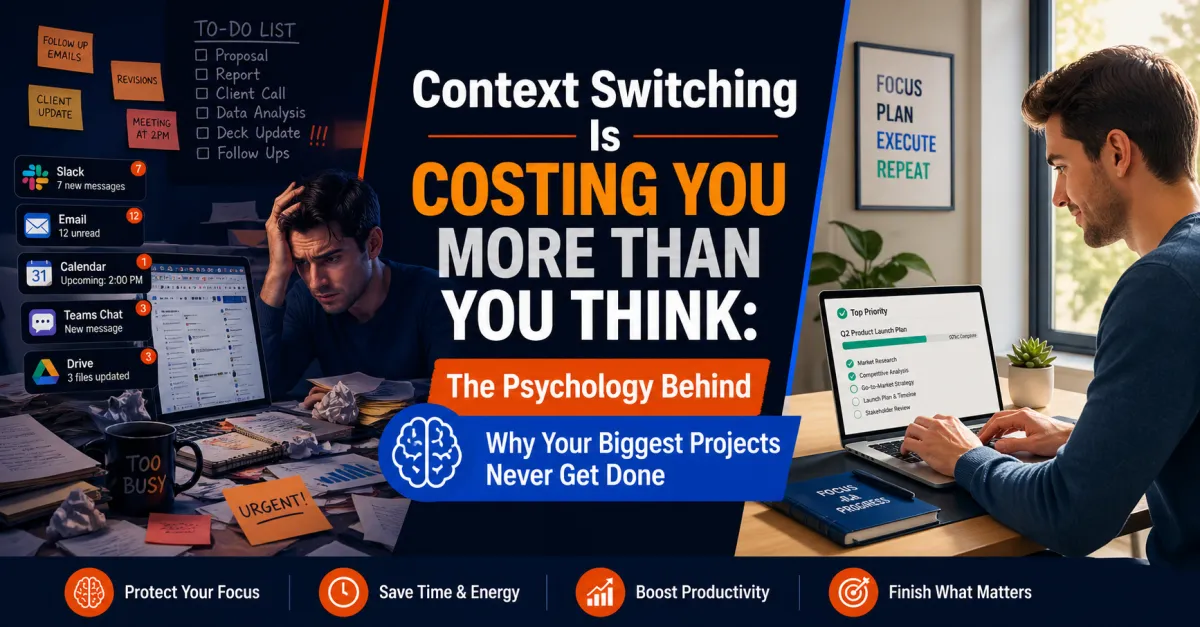
Context Switching Is Costing You More Than You Think: The Psychology Behind Why Your Biggest Projects Never Get Done
There's a moment most business owners know well. You're deep in a project—real, meaningful work—and you're finally in flow. Then someone pings you. A quick question. A small detour. And just like that, the thread is gone.
Most people assume they just "got distracted." What actually happened is far more complex, and far more damaging to your output than you probably realize.
What the Research Actually Says About Interruptions
Here's the thing that changed how we think about our entire workday: it doesn't just take time to recover from an interruption. It takes nearly twice as long to get back into flow as it took to get into flow in the first place.
Let's say you sit down and it takes you 10 minutes to get your head fully wrapped around a project. You work for 45 minutes. You're in it. Then someone knocks on the door—hey, quick question about lunch.
When you return, it doesn't take 10 minutes to get back. It takes 20. Because your brain doesn't reload from the save point of where you were interrupted. It reprocesses from the beginning—scanning everything you accomplished from minute one all the way back up to the moment of interruption, just to figure out where it was.
Every single time this happens, you're paying a cognitive tax that compounds throughout your day.
The Ovsiankina Effect: When Your Brain Turns Unfinished Work Into a Survival Imperative
This is where it gets psychologically fascinating—and a little alarming.
When we're working on a project and keep getting interrupted, our brain activates something called the Ovsiankina effect. Here's what it does: it shifts an incomplete task from a "want" to a "quasi-need."
The difference matters enormously. A need is something tied to survival. A want is simply something desirable. Your unfinished website copy is not, objectively, a survival-level emergency. But if you leave that context window open long enough—repeatedly interrupted and never resolved—your nervous system stops treating it like a want. It starts generating genuine anxiety. The same stress indicators, physiologically, as someone who has been in an active threat situation.
You're sitting at your desk, drinking coffee, and your body is producing a stress response that resembles being in a combat zone. All because you haven't finished writing the email sequence you keep getting pulled away from.
This is why some of us feel inexplicably anxious about work even when we're not actively doing it. The open loops accumulate. The quasi-needs multiply. And the cognitive weight becomes crushing.
As Csikszentmihalyi describes it, when we're in flow state and anything interrupts that, we don't just lose time—we lose the entire psychological architecture that was supporting the work.
Ego States: The Missing Framework for Understanding Why Task-Switching Costs So Much
Here's a layer that most productivity frameworks completely miss, and it's the one that made everything click for us.
When you switch between tasks, you're not just switching topics. You're switching ego states—the different versions of you that show up for different kinds of work. Think of it like a table where different parts of you sit down depending on what's needed.
When you're working on billing for one business, all the relevant parts are already at the table. If you have to switch to another billing task for a different company, the same parts stay seated. The cognitive transition is minimal—you're still in the same category of work, drawing on the same mental resources.
But if you switch from billing to customer service that requires empathy, creative problem-solving, and a completely different emotional register? Different parts have to leave the table. New ones have to arrive. That transition—those ego states checking out and new ones checking in—is what produces the real cost of context switching.
This is also why some people, when they get stuck in a particular emotional state, stay there for an entire day. The ego state that arrived—whether it's frustration, anxiety, or overwhelm—becomes the operating system, and every other function runs through it until something breaks the pattern and allows a reset.
The Category Rule: A Simple Shortcut That Minimizes Switching Costs
Understanding that context switching is about categories rather than individual tasks gives you a practical tool you can use immediately.
The goal isn't to do only one thing forever. It's to batch your work by category of cognitive demand—not just by topic. The key insight is that switching within a category costs far less than switching between categories.
If you spend a morning block entirely in creation mode—recording training videos, writing copy, developing content—your brain stays in a consistent ego state the entire time, even across different projects. The moment you jump from recording a video to answering a billing question to handling a customer complaint, you're paying the full switching tax three times over, often in the span of an hour.
Here's a real example: working on billing for one business and then switching to billing for a different business is a low-cost switch—the same parts are already at the table. But switching from billing to a customer service issue that has nothing to do with billing? Now you have to bring on a different hat, a different version of yourself, and that's the switching part that kills productivity.
The "Must-Not" List: Why Your Big Three Projects Need a Bodyguard
Most people are familiar with the concept of prioritizing your top three projects for a quarter. This is a core tenant of the Pykthos Growth System that we teach Mastermind members. Fewer people understand that the priority list is only half the system.
The other half is the must-not list—an explicit, written-down commitment to what you are not allowed to work on until your top priorities are handled. Tim Ferriss has talked about versions of this. The insight is that without the must-not list, every priority exists in permanent competition with everything else that feels urgent.
Here's what this looks like in practice: You define your Big Three projects for the quarter. You document them. And then you write, explicitly, what you must not do—what categories of work, what new projects, what interesting opportunities you are prohibited from touching—until meaningful progress on the Big Three is made.
The rule is simple: your top priorities must have a bodyguard, and that bodyguard is a list of everything that isn't them.
Without this, what tends to happen is that you plan, get excited, do a bit of work on the big project, and then spend three months working on a dozen other things. The big project gets done at the last possible moment, if at all, because it was always in competition with everything else.
With the must-not list, you create a psychological forcing function. The project that matters most is the only thing you're allowed to be doing. We know this works because applying it helped us get 80% of a major project done in two weeks—a project that had been stalled for months.
The Hypnotic Shortcut: Installing a Mental Workspace
One of the most practical solutions to the interruption problem came from an unexpected angle—hypnotherapy.
The idea is this: rather than relying solely on environmental conditions to get into flow, you can create an internal mental workspace that you anchor to your most productive state. A place you can access in seconds, regardless of what's happening around you.
The mechanics are straightforward. Through a light hypnotic process, you build a detailed internal environment—a studio, a workshop, whatever resonates—and you associate that space with your deepest, most focused work. You create a ritual pathway to get there. The pathway itself becomes the anchor.
One of our members describes her version as a secret island laboratory. She rows across a lake to get there. The whole process takes about 20 seconds. Once she's in, it doesn't matter what's happening around her—kids, noise, chaos. She's in the workspace. The interruption cost drops dramatically.
For creatives working in open-plan offices, for parents with young children, for anyone whose work environment is inherently interrupt-driven, this kind of internal workspace isn't a luxury—it's a competitive advantage.
It's also worth noting, as Terance pointed out in our group, that different brains genuinely like different things. Some people thrive surrounded by noise and activity. Others, like Alex Hormozi, need a sealed room with no windows, soundproofing, and big headphones. The goal isn't to force everyone into the same setup—it's to understand what your particular brain needs and build the conditions that support it.
Sophisticated Procrastination: The Trap That Catches Even the Most Self-Aware People
One more thing worth naming, because it's the trap that catches even the most self-aware people.
Perfectionism and excessive learning are just sophisticated procrastination. They feel like productive activities. They look like productive activities from the outside. But if they're consistently happening at the expense of your actual output, they're performing the same function as scrolling social media—just with better optics.
We had a conversation with Gemini about this recently, and it produced a line worth writing down: learning and perfectionism are just fancy ways of procrastinating. Sophisticated procrastination.
Spending three weeks researching the perfect project management system instead of building the thing you said you'd build? Sophisticated procrastination. Getting another certification before you feel ready to work with clients? Sophisticated procrastination. Endlessly refining the plan that's already good enough to execute? Sophisticated procrastination.
The moment you can recognize sophistication as a disguise, you gain the ability to call it what it is and redirect.
What This Means for How You Structure Your Days
Put this all together, and you get a productivity framework grounded in how cognition actually works:
Define your Big Three projects for the quarter and document them clearly
Create an explicit must-not list that protects your priorities from competition
Batch by cognitive category, not just by topic or project
Build a re-entry ritual—whether through hypnotic anchoring or a physical routine—that reduces the cost of interruptions when they're unavoidable
Name sophisticated procrastination when it shows up wearing the costume of learning or perfectionism
The productivity gains from applying even two or three of these consistently are not incremental. They're the kind that let you get 80% of a major project done in two weeks that would otherwise take three months of scattered effort.
That's not an exaggeration. That's just what focused work actually looks like, uninterrupted.
Ready to identify your own context-switching patterns and build a work structure that actually protects your highest-priority projects? Come work through it with us—it's the kind of clarity that changes how you operate for years. https://pykthos.com/mastermind


