





The $5 vs $5,000 Task Framework for Your Hypnosis Practice
The $5 vs $5,000 task framework sorts your work by what it's worth. Some tasks are $5-an-hour work (downloading files, data entry) and some are $5,000-an-hour work that only you can do (sessions, offers, key decisions). List every task you do, put an asterisk next to the ones that must be you, then eliminate, automate or delegate the rest. Start with one change this week.
Key takeaways
- Most practitioners list 20 to 40+ tasks they handle themselves; only a handful truly need them.
- Ask three questions of every task: does it have to be me, what would I hand a free assistant, and can it be eliminated, automated or delegated?
- Eliminate first. The best part is no part: an unrequested custom recording is 'invisible over-delivery'.
- The money tiers ($5, $50, $500, $5,000) come from Perry Marshall's 80/20 Sales and Marketing, as Chris explains below.
- Automate what you do weekly or more; do it by hand if it happens five times a year.
I'll never forget the moment I realized I was working for less than $10 an hour in my own business.
There I was, spending 45 minutes creating a custom hypnosis recording for a client who'd already paid me $100 for their session. Then another hour editing a personalized workbook. Then 30 minutes manually responding to Instagram DMs with the same information I'd typed out dozens of times before.
The math was brutal. After accounting for all the unpaid work, the learning, the prep, the follow-up, the administrative tasks, I was barely scraping minimum wage.
And I wasn't alone.
What does doing everything yourself really cost?
During our recent mastermind call, we ran an eye-opening exercise. I asked everyone to spend just 5 minutes listing every single task they do in their business. No judgment, no filtering, just write it all down.
What happened next shocked even me.
Practitioners were listing 20, 30, even 40+ different tasks they were personally handling. Recording videos, editing content, responding to emails, bookkeeping, creating workbooks, managing social media, writing scripts, building websites, doing graphic design...
The list went on and on.
One practitioner admitted she was creating custom audio recordings for every single client, recordings that took significant time to produce but weren't even part of her original offer. She was literally giving away hours of unpaid work because she thought clients expected it.
Another was spending hours each week manually responding to Instagram DMs, reading through old conversations trying to remember where they'd left off with each prospect.
Sound familiar?
What is the $5 vs $5,000 task framework?
Here's the truth most hypnosis schools won't tell you: Just because you CAN do something doesn't mean you SHOULD.
I use a simple framework to evaluate every task in my business. I ask three questions:
Question 1: Does this task absolutely have to be me?
Put an asterisk next to anything that only you can do. For most of us, this includes:
Conducting actual client sessions
Recording videos where you're on camera
Discovery calls with potential clients
Creating your core methodology and offers
Continuing education in your craft
Notice what's NOT on that list? Pretty much everything else.
Question 2: If someone handed me a free, full-time assistant tomorrow, what would I immediately delegate?
This thought experiment is powerful because it removes the excuse of "I can't afford help." We're not talking about hiring yet, we're talking about identifying what SHOULDN'T be you.
When I asked this question during our mastermind, practitioners suddenly realized:
Video editing doesn't have to be them
Bookkeeping doesn't have to be them
Scheduling doesn't have to be them
Email responses don't have to be them
Social media posting doesn't have to be them
Question 3: Can this task be eliminated, automated, or delegated?
This is where the magic happens. Every task that doesn't absolutely need to be you has three possible fates:
ELIMINATE: Maybe you don't need to do it at all. One practitioner was spending hours on "overly produced" videos that weren't getting better results than simple phone recordings would. He eliminated all that production work entirely. (For a closer look at that trap, see the custom recording trap.)
AUTOMATE: Use AI tools or software to handle it. One practitioner was manually responding to the same Instagram DM questions repeatedly. We set up an automation that handles initial responses, asks qualifying questions, and books discovery calls, all without her lifting a finger.
DELEGATE: Hand it to a human (virtual assistant, contractor, or AI). Another practitioner was creating custom workbooks for every client. We helped her create templated workbooks that an AI could customize based on session transcripts, 90% time savings.
Why are most practitioners secretly working for minimum wage?
Let me hit you with an uncomfortable truth: if you're charging $100 per session as a hypnotherapist, you're probably making about $10 an hour.
Yes, you read that right. Ten dollars per hour.
Before you close this tab in protest, hear me out. When you factor in all the unpaid work, the custom workbooks you create for clients, the personalized audio recordings, the social media content planning, the DM responses, the bookkeeping, the website tweaking, your actual hourly rate plummets faster than a failed rocket test.
And speaking of rocket tests, there's a fascinating lesson from Elon Musk's engineering philosophy that applies directly to your hypnotherapy practice.
The Elon Musk Approach to Business Tasks
In Walter Isaacson's biography of Elon Musk, there's a revealing pattern in how SpaceX approaches engineering problems. When building rocket engines, the team would deliberately remove parts to see what happens. They'd err on the side of taking too many components out, knowing that 20% of the time they'd have to add something back because the rocket failed.
But here's the key: they'd rather test without a part and occasionally fail than continue using unnecessary components that add weight, complexity, and cost.
What if you applied this same ruthless elimination strategy to your business?
The Five-Minute Exercise That Changed Everything
Recently, I led our Pykthos Mastermind through a deceptively simple exercise. I gave everyone five minutes to write down everything they do in their business. Not the things they want to do. Not the things they should do. The actual tasks consuming their time and energy.
The results were eye-opening.
One practitioner listed creating custom audio recordings for every client. Another spent hours crafting personalized workbooks. A third was manually responding to dozens of Instagram DMs daily, trying to convert cold leads into $49 introductory sessions.
Then came the critical second step: mark which tasks absolutely, positively must be you.
The Asterisk Test: What Really Requires Your Genius
Here's how the exercise works. Look at your list and put an asterisk next to only the tasks that meet this criteria: nobody else can do this, and it cannot be automated, delegated, or eliminated.
For most hypnotherapists, your asterisk list should be shockingly short:
Conducting actual client sessions (though even this could eventually be delegated if you built a clinic model)
Appearing on camera for your content (if you're building a personal brand)
High-level strategic thinking about your offers and positioning
Continuing education in your craft
That's pretty much it.
Everything else? Fair game for elimination, automation, delegation, or AI assistance.
The Three Pathways Out of Minimum-Wage Entrepreneurship
Once you've identified the tasks that don't require your unique genius, you have three options:
Option 1: Eliminate (The Rocket Scientist Approach)
Sometimes the best solution is to simply stop doing something. Remove the part entirely.
Take the practitioner creating custom audio recordings for clients. She was spending significant time each month producing 7-8 minute personalized hypnosis tracks. Noble? Absolutely. Necessary? Questionable.
The hard truth: if you're doing excellent work in the actual session, incorporating future pacing, and checking your work, what advantage does a custom audio provide? Especially if it's not part of your sales pitch and clients don't know to expect it?
This is what I call "invisible over-delivery." You're working for free on something clients never requested, might not use, and doesn't materially improve outcomes.
The solution? Either eliminate it entirely, or better yet, turn it into a paid add-on (a bump offer). At minimum, build a library of 10-20 pre-recorded sessions addressing common issues that you can provide as bonuses instead of creating custom ones.
Option 2: Automate (Let Technology Do the Heavy Lifting)
One member was manually tracking Instagram DMs, reading through conversation histories, and trying to remember where she left off with each prospect. The mental load alone was exhausting.
The fix? A simple CRM automation that:
Captures every DM interaction
Logs contact information automatically
Reminds you when to follow up
Sequences responses based on where prospects are in the journey
This isn't futuristic technology. This is available right now, often for less than $100 per month.
Option 3: Delegate (The "Who Not How" Revolution)
There's a brilliant book called Who, Not How (by Dan Sullivan with Dr. Benjamin Hardy) that reframes how we approach problems. Instead of asking "How do I do this?" we should ask "Who can help me accomplish this?"
As an engineer by training, this was my Achilles heel. My natural instinct when facing a problem is to dive in and figure out how to fix it myself. But that's the path to burnout and minimum wage.
The breakthrough comes when you realize: someone else has already mastered the thing you're struggling with.
Video editing? There are people who've done it for years and can accomplish in 30 minutes what takes you three hours.
Bookkeeping? There are specialists who can handle your taxes without you risking "knowing just enough to be dangerous."
Website design? Stop trying to learn CSS. Find your Randy (our web designer who makes magic happen without us needing to understand the technical details).
What happened when Mary automated her Instagram DMs?
Let me share what happened with Mary, one of our mastermind members.
She was running Instagram ads for $49 hypnosis sessions. Great. But then she was manually responding to 5-8 DMs per day, having lengthy back-and-forth conversations to overcome objections, carefully crafting each message, and trying to remember where she'd left off with each person.
Her time investment per booked client? Probably 2-3 hours of messaging spread across several days.
Here's what we implemented:
Step 1: Created an automated first response that waits 60 seconds (so it seems human), uses the prospect's name via merge fields, and asks one powerful open-ended question: "What change are you looking to make in your life?"
Step 2: Based on their response, the system sends targeted educational content or a short video that addresses their specific concern.
Step 3: After demonstrating value, the automation offers a calendar link to book a discovery call, no phone number required, no back-and-forth scheduling.
The result? Mary gets her time back for actual client work while maintaining (and likely improving) her conversion rate.
What does a lean solo practice look like?
Here's what I've discovered works for solo practitioners in 2024:
You + Part-Time VA + AI Tools = Complete Business System
That's it. You don't need a huge team. You don't need to become a tech expert. You need:
You: Doing the high-value work only you can do (sessions, core content, strategy)
A part-time virtual assistant: Handling the tasks that need a human touch but don't need YOUR human touch
AI tools: Automating everything else (email responses, content creation, scheduling, note-taking, transcription)
This setup couldn't exist three years ago. Now it can. And it's ridiculously affordable.
The Real Cost of DIY Everything
Here's what most people don't realize: the true cost of entrepreneurship isn't the software subscriptions or the occasional contractor. It's the massive mental and emotional tax of trying to do everything yourself.
As one person in our mastermind said, "This is probably the hardest job I've ever had, and I was in the infantry."
The cognitive load of wearing every hat, marketer, bookkeeper, content creator, tech support, session provider, curriculum designer, is crushing. And it keeps you from the $5,000-per-hour activities that actually grow your business.
What does $5 work look like in a real business? Chris's story
In his own words, from Pykthos co-founder Chris Thompson:
Every Wednesday and Friday, I had the same routine.
Our Pykthos mastermind call would end. I'd log into Zoom. Download the recording. Upload it to Google Drive. Copy the transcript. Paste it into ChatGPT. Ask for a summary. Copy that summary somewhere else.
Rinse and repeat for every single call we recorded.
It wasn't difficult work. Maybe 15-20 minutes per recording. But it was constant. And it was eating up hours of my week doing something that, frankly, I shouldn't have been doing at all.
My business partner Timothy had been telling me this for months: "Chris, you're doing $5 an hour work. You need to stop."
He was right. And the framework he kept pushing me toward completely changed how I think about my time.
The Four Categories of Work
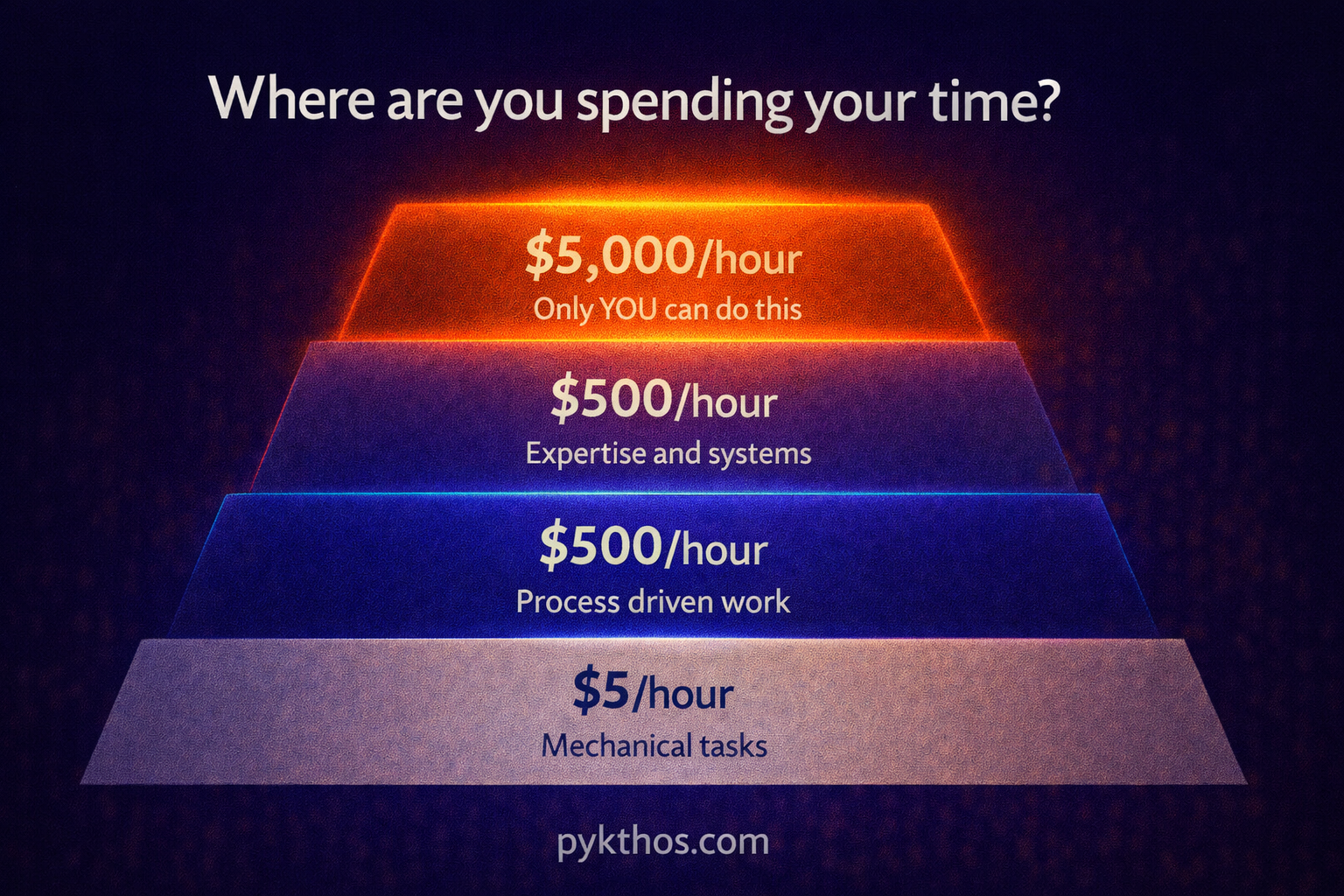
Here's the framework that Timothy taught me, and it's based on the 80/20 principle from Perry Marshall's book "80/20 Sales and Marketing."
Every task in your business falls into one of four categories:
$5/hour work - This is purely mechanical stuff. Downloading files from Zoom. Uploading videos to Google Drive. Moving files between folders. Basic data entry. Anyone could do this work with minimal training.
$50/hour work, This requires some skill but follows established processes. Writing blog post summaries. Uploading content to YouTube. Creating graphics from templates. Scheduling social media posts. It's still process-driven, but needs a bit more judgment.
$500/hour work, This is where your expertise starts to matter. Building your course content. Creating your intellectual property. Designing your service delivery systems. Training your team. This work leverages your knowledge but still follows your strategic direction.
$5,000/hour work - This is the work that ONLY you can do. Showing up for your hypnosis sessions. Teaching your signature classes. Creating new offers. Building strategic partnerships. Making key business decisions. This work directly generates revenue or creates strategic advantage.
Here's the problem: Most entrepreneurs spend 60-80% of their time doing $5 and $50 work, leaving almost no time for the $5,000 activities that actually grow their business.
I was definitely guilty of this. And I see it constantly in our community, brilliant practitioners who are exceptional at their craft but stuck in the administrative weeds.
What This Actually Looks Like
Let me give you a real example from our business.
We run multiple calls every week, Wednesday masterminds, Friday co-working sessions, and various trainings. Each call generates a Zoom recording that needs to be processed.
My original process:
Log into Zoom (manual)
Download each recording (manual)
Upload to Google Drive (manual)
Copy the transcript (manual)
Paste into ChatGPT (manual)
Request a summary (manual)
Copy summary to our shared doc (manual)
Update the team (manual)
Time per recording: 15-20 minutes
Frequency: 3-5 times per week
Total weekly time: 60-100 minutes
Annual time: 52-87 hours
That's more than two full work weeks per year spent downloading and uploading files.
Now here's what we built using an automation platform called N8N:
When a Zoom recording completes:
1. Automatically download the recording
2. Upload it to our designated Google Drive folder
3. Extract the transcript
4. Send the transcript to Claude AI for summarization
5. Save everything in a structured folder
6. Send a notification to our team
Time per recording: 0 minutes (fully automated)
We still review everything, there's always a human in the loop checking the summaries and deciding what to do with the content. But the mechanical work of moving files around? That's gone.
The Real Cost of Low-Value Work
Here's what most people don't realize: The work you're doing to "save money" is actually the most expensive decision you're making.
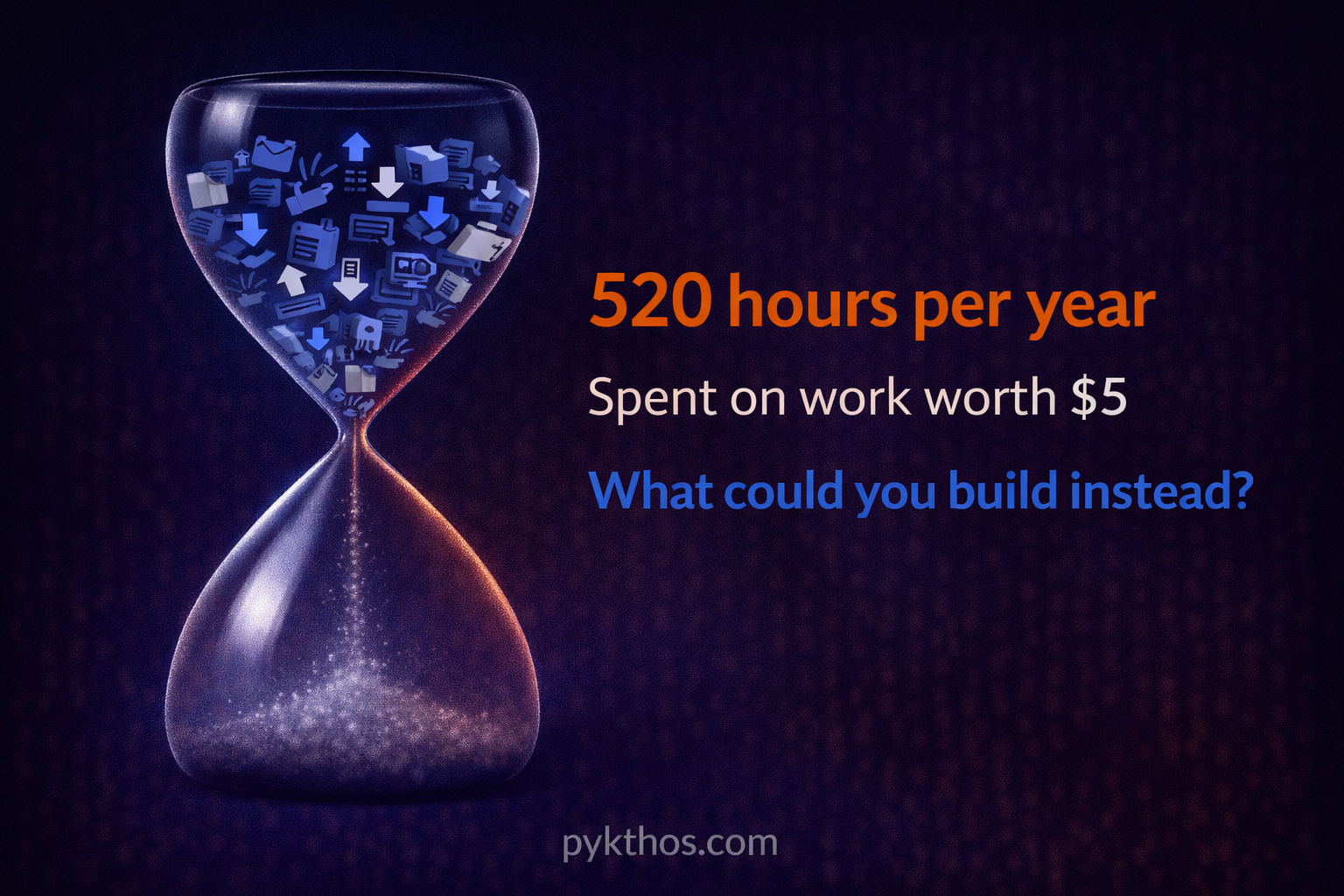
Let's say you're spending 2 hours per day on $5-$50 work. That's 10 hours per week. That's 520 hours per year.
What if you used even half of those hours on $5,000 work instead? Creating new offers. Having sales conversations. Building strategic relationships. Recording that signature training you've been putting off.
Even if we're conservative and say it's only worth $500/hour of actual value creation, that's $130,000 you're leaving on the table by doing low-value work.
But here's what makes this trap so insidious: the low-value work feels productive. You're checking things off your list. You're "getting things done." It gives you that little dopamine hit of completion.
Meanwhile, the high-value work, creating that new offer, recording that webinar, reaching out to that potential partner, sits untouched on your someday/maybe list.
The DEAL Framework for Escaping the Trap
So how do you actually escape this? You need a systematic approach.
I use a framework adapted from Tim Ferriss called DEAL:
D, Define what the task actually accomplishes. What's the end result you need?
E, Eliminate wherever possible. Do you actually need this done at all? Elon Musk says "the best part is no part" - can you design this task out of your business entirely?
A, Automate what remains. Can technology do this faster, cheaper, and more consistently than a human?
L, Liberate your time for high-value work. The goal isn't just efficiency, it's freedom to focus on what matters.
Let me be clear: Not everything needs to be automated. In fact, trying to automate everything is its own form of $50 work trap.
Here's my rule: If you're doing it 5 times a year, just do it manually. If you're doing it 5 times a week, automate it or delegate it immediately.
The sweet spot for automation:
You do it repeatedly (weekly or more)
It follows the same steps every time
It doesn't require creative judgment
It takes more than 10 minutes to complete
For everything else, consider delegation first. A virtual assistant at $15-25/hour can handle most $5 and $50 work, and you don't need to spend time building automation systems.
But I'm Not Technical, Can I Really Do This?
Here's the honest truth: I'm not a programmer. Neither is Timothy.
We learned how to build these automations by asking Claude AI to teach us, step by step. We'd hit a problem, describe it to the AI, and it would walk us through the solution.
Claude taught us about OAuth, secret keys, API calls, and how to structure data flows. Yes, we made mistakes. Yes, things broke sometimes. But the AI was patient, and it helped us troubleshoot every issue.
Timothy even built a Python script that scrapes all his Zoom recordings and downloads them automatically. He's not a Python developer, he just asked AI how to do it and followed the instructions.
That said, you don't need to become a technical expert. You have three options:
1. Learn it yourself - Use AI assistants to guide you through building automations
2. Hire someone, Pay a specialist $25-50/hour to build it for you
3. Use done-for-you systems, Platforms like Pykthos include pre-built workflows you can just activate
The key is making the decision to stop doing the low-value work yourself.

Start With One Thing
If you're feeling overwhelmed, don't try to automate everything at once.
Just pick one thing. One repetitive task that you do every week that makes you think "ugh, I have to do this again."
For me, it was downloading Zoom recordings.
For our community member Tai, it was sending webinar reminders.
For Matt, it was uploading content and writing summaries.
For April, it's delivering her lead magnet hypnosis audio.
Pick the one thing that, if automated, would give you back the most time or mental space.
Then make a decision: Will you automate it, delegate it, or eliminate it?
Just not doing it yourself anymore will free up the mental space and actual time you need to focus on the work that only you can do.
The Mindset Shift That Changes Everything
Here's what I've learned: Your job as an entrepreneur isn't to do all the work. Your job is to architect systems that do the work.
Every hour you spend downloading Zoom recordings is an hour you're not:
Creating your next offer
Recording that signature training
Having a discovery call with a potential client
Deepening a strategic relationship
Being present with your family
The low-value work will always be there, waiting to fill your day. It's comfortable. It's familiar. It feels like progress.
But it's keeping you small.
As C-level executives in our businesses, we should be doing $5,000 work. Showing up for our sessions. Teaching our classes. Building the business through ideation and strategy.
Everything from $500 down should be automated or delegated. And yes, you'll still be involved in the $500 work, training, reviewing, approving. But you shouldn't be the one executing it.
How do you start? A 7-day action plan
Day 1-2: Do the 5-minute task inventory exercise. Write down EVERYTHING you do in your business.
Day 3: Go through your list and put an asterisk next to tasks that absolutely must be you. Be ruthless. If you hesitate even a little, no asterisk.
Day 4: For each non-asterisk task, write one of three words next to it: ELIMINATE, AUTOMATE, or DELEGATE.
Day 5-6: Pick your top 3 time-wasters and brainstorm solutions. Can you eliminate them entirely? What tools could automate them? Who could do them instead?
Day 7: Implement ONE change. Just one. Maybe it's setting up an automated email response. Maybe it's stopping those custom recordings you were never paid to create. Maybe it's using an AI tool to draft your social media captions.
One change. One win. Then build from there.
The Permission You've Been Waiting For
I'll close with this: you don't have to know how to do everything. You don't get bonus points for doing it the hard way by yourself. And you're not a better practitioner because you manually handle every aspect of your business.
You're a hypnotherapist. Your genius is in the transformation you create for clients, not in your ability to edit videos or manage spreadsheets.
So stop paying yourself minimum wage. Start protecting your time like the valuable resource it is. And remember: sometimes the best thing you can do is remove the unnecessary part entirely.
The rocket might just fly higher.
The Bottom Line
I used to think that doing everything myself made me a dedicated practitioner. Now I realize it just made me a broke one.
The practitioners who scale aren't the ones who can do everything. They're the ones who know what to do themselves and what to systematize.
Your time is your most valuable asset. Every hour you spend on a $5 task is an hour you can't spend on a $5,000 task, like creating offers, serving clients, or building systems that generate revenue while you sleep.
Stop being the reason there's a sign that says "do not distract the driver."
Start driving the bus.
Related reading
- A 3-step system to eliminate busywork
- What context switching really costs you
- The Big Three: a 90-day planning framework
Frequently asked questions
What is $5 work?
Purely mechanical tasks anyone could do with minimal training: downloading files from Zoom, uploading videos, moving files between folders, basic data entry.
What tasks should only I do in my practice?
Usually a short list: client sessions, being on camera, discovery calls, creating your core methodology and offers, and continuing education in your craft. Nearly everything else can be eliminated, automated or delegated.
When should I automate a task instead of delegating it?
Automate tasks you do weekly or more that follow the same steps every time, need no creative judgment and take more than 10 minutes. If you do something five times a year, just do it by hand; for most other $5 and $50 work, consider a virtual assistant first.
Where does the $5 vs $5,000 idea come from?
Chris credits the four tiers to the 80/20 principle in Perry Marshall's book 80/20 Sales and Marketing; the DEAL steps are adapted from Tim Ferriss.
Take the Next Step
Want the step-by-step version? Read the 3-step system to eliminate busywork.
Ready to build your lean, automated practice? Join us in the Pykthos Mastermind where we help hypnosis practitioners eliminate busywork and focus on what actually grows their business. Check out: https://pykthos.com/mastermind to learn more.
Published May 11, 2026. Last updated October 26, 2026.


