



Your Clients Are Raising Their Hands (Are You Noticing?)
You're already doing the hard part—changing lives, building trust, and staying connected with your people through email.

Maybe you're sending out weekly tips, promoting an upcoming workshop, or sharing a free resource you created. You're not a beginner. You've got real clients and real things to say.
But here's the question most practitioners never ask: What happens after you hit "send"?
Because if someone clicks a link in your email, that tiny moment—that little click—is one of the most important signals in your entire business. And if you're not paying attention to it, you're missing conversations that are already trying to happen.
The Signal You're Probably Missing
Most solo practitioners send emails, but once it goes out, that's kind of… it. Maybe someone replies. Maybe they don't. You move on to the next client, the next session, the next thing.
But here's what's actually happening: some of your readers are leaning in. They're clicking links. They're checking things out. They're raising their hands and saying, "I'm curious about this."
And then… nothing. Because you didn't notice.
If you're not tracking link clicks, you're missing one of the simplest ways to spot interest and follow up in a way that actually feels human.
A Click Is Someone Raising Their Hand

Let me give you a real example from our own business.
We offer a free report that helps practitioners build their first real marketing plan. When someone opts in, we deliver the PDF. Simple enough.
But here's where it gets interesting: not everyone who requests the report actually opens it.
Some people download it and never look at it. That's fine—they were curious but not ready. But some people click through and read the entire thing. And when they do, that tells us something important.
That click means they're not just passively interested. They're actively exploring. They're thinking about their business. They're considering what's next.
So we follow up. Not with a hard pitch, but with a simple message:
"Hey [Name], I saw you checked out the marketing plan report. What stood out to you? And if you'd like help actually implementing this in your practice, we'd love to tell you more about our mastermind—just reply and let me know."
That's it. No pressure. Just noticing that they raised their hand, and giving them an easy way to keep the conversation going.
And it works. We get replies. We start real conversations. Some of those people become members.
Why People Click But Don't Follow Through
Here's something you probably recognize: someone clicks a link in your email—maybe to book a call, sign up for an event, or check out an offer—but they don't actually complete the action.
They get to your booking page… and leave.
They look at your program details… and close the tab.
They read your sales page… and disappear.
Why?
It's rarely because they're not interested. More often, it's because they're hesitating. They might be thinking:
"Is this going to be a sales pitch?"
"I don't know this person well enough yet."
"I need to think about it."
"What if it's not the right fit?"
These aren't objections. They're just human hesitation. And the beautiful thing is, a simple follow-up can dissolve most of that uncertainty.
When you reach out after someone clicks, you're not being pushy. You're being present. You're making it easier for them to move forward by starting the conversation where they actually are—curious but cautious.
What a Good Follow-Up Actually Looks Like

Let's say you send an email inviting people to book a discovery call. Someone clicks the link to your calendar, looks around, but doesn't book.
Most practitioners would just hope they come back later. But what if you followed up like this:
"Hey [Name]—I noticed you were checking out my calendar. I'm curious, what's on your mind? What made you think about booking a call?
If you'd rather start the conversation here by email, that works too. No pressure either way—just wanted to make it easy for you to reach out if it felt like a good fit."
You're not selling. You're not guilting them. You're just acknowledging that they showed interest, and you're offering to meet them where they are.
That kind of message does two powerful things:
It reassures them this isn't a high-pressure situation
It gives them permission to respond in a way that feels comfortable
And the result? More conversations. More clarity. More clients.
You Don't Have to Track This Manually
Here's the best part: you don't need to sit there refreshing reports or checking who clicked what.
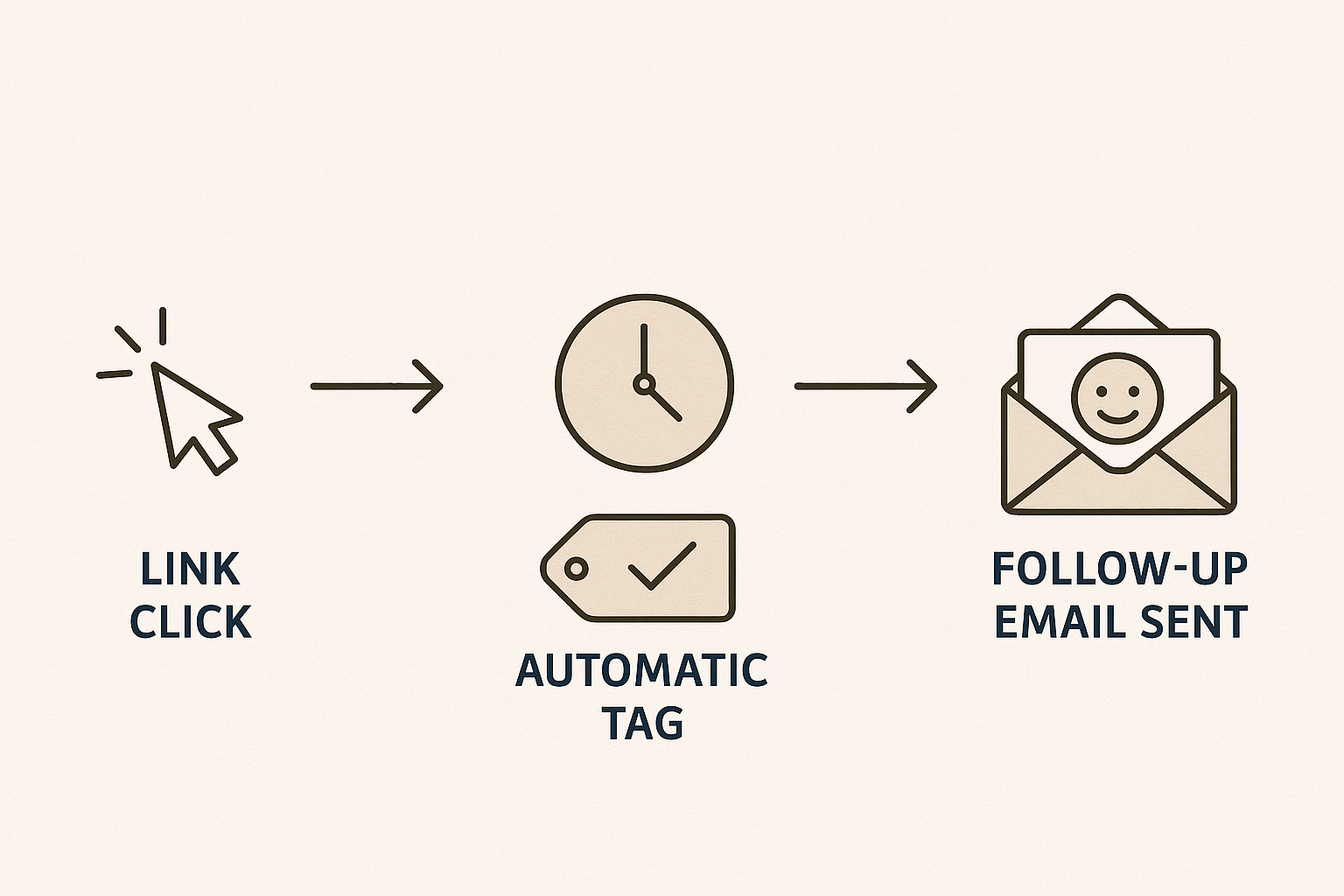
With the right system, this happens automatically. When someone clicks a specific link in your email, they get tagged. A day or two later, a follow-up message goes out. You don't have to remember anything. You don't have to wonder if you're being "too pushy." It just works.
That's what real automation is for—not to replace you, but to help you notice the moments that matter and respond like the caring practitioner you already are.
This Isn't About Data—It's About Being Present
I know "tracking" can sound cold or analytical, like you're monitoring people. But that's not what this is.
You're not analyzing spreadsheets. You're not obsessing over conversion rates. You're simply noticing when someone leans in—and responding like a real person who cares.
Link clicks are little signals that someone is thinking about working with you, learning from you, or taking a next step with you. When you pay attention to those signals, your conversations get better. Your follow-ups feel more natural. And yes, your business grows—but in a way that actually feels good.
Try This Today
Here's something you can do right now, even if you're not particularly "tech-savvy":
Pick your last email. Go into whatever platform you use (even if it's just basic email software) and check:
Did anyone click a link?
What link was it?
Who clicked?
Now pick one person who clicked, and send them a short, personal message:
"Hey [First Name], I saw you were checking out [whatever they clicked]. What were you thinking about exploring? Happy to chat by email if that's easier—or if you want to hop on a quick call, here's the link again."
That's it. You just practiced real marketing—the kind that connects.
You Don't Need More Hustle—You Need Better Systems
You don't need a massive email list. You don't need to become a marketing expert overnight. You just need to start noticing what your potential clients are already telling you—with their clicks.
If someone is curious, show up for them.
If someone raises their hand, respond.
That's how your business grows—not through grinding harder, but through small, smart systems that help you have the right conversations at the right time.
And that's exactly what we teach inside Pykthos Mastermind.
If you're a hypnotist, coach, or wellness practitioner who's ready to finally build a real marketing system—one with automation that actually works, clear frameworks you can follow, and a community of people doing the same thing—check out Pykthos Mastermind here.
You'll get the platform, the coaching, and the strategic blueprint to grow your practice with confidence. Not more hustle. Just clarity, structure, and a path forward.
Because the clients you're looking for? Some of them are already raising their hands. You just need to start noticing.


