






Stop Doing $5 Work: The Simple Framework That Freed Up 200+ Hours in My Business
Every Wednesday and Friday, I had the same routine.
Our Pykthos mastermind call would end. I'd log into Zoom. Download the recording. Upload it to Google Drive. Copy the transcript. Paste it into ChatGPT. Ask for a summary. Copy that summary somewhere else.
Rinse and repeat for every single call we recorded.
It wasn't difficult work. Maybe 15-20 minutes per recording. But it was constant. And it was eating up hours of my week doing something that, frankly, I shouldn't have been doing at all.
My business partner Timothy had been telling me this for months: "Chris, you're doing $5 an hour work. You need to stop."
He was right. And the framework he kept pushing me toward completely changed how I think about my time.
The Four Categories of Work
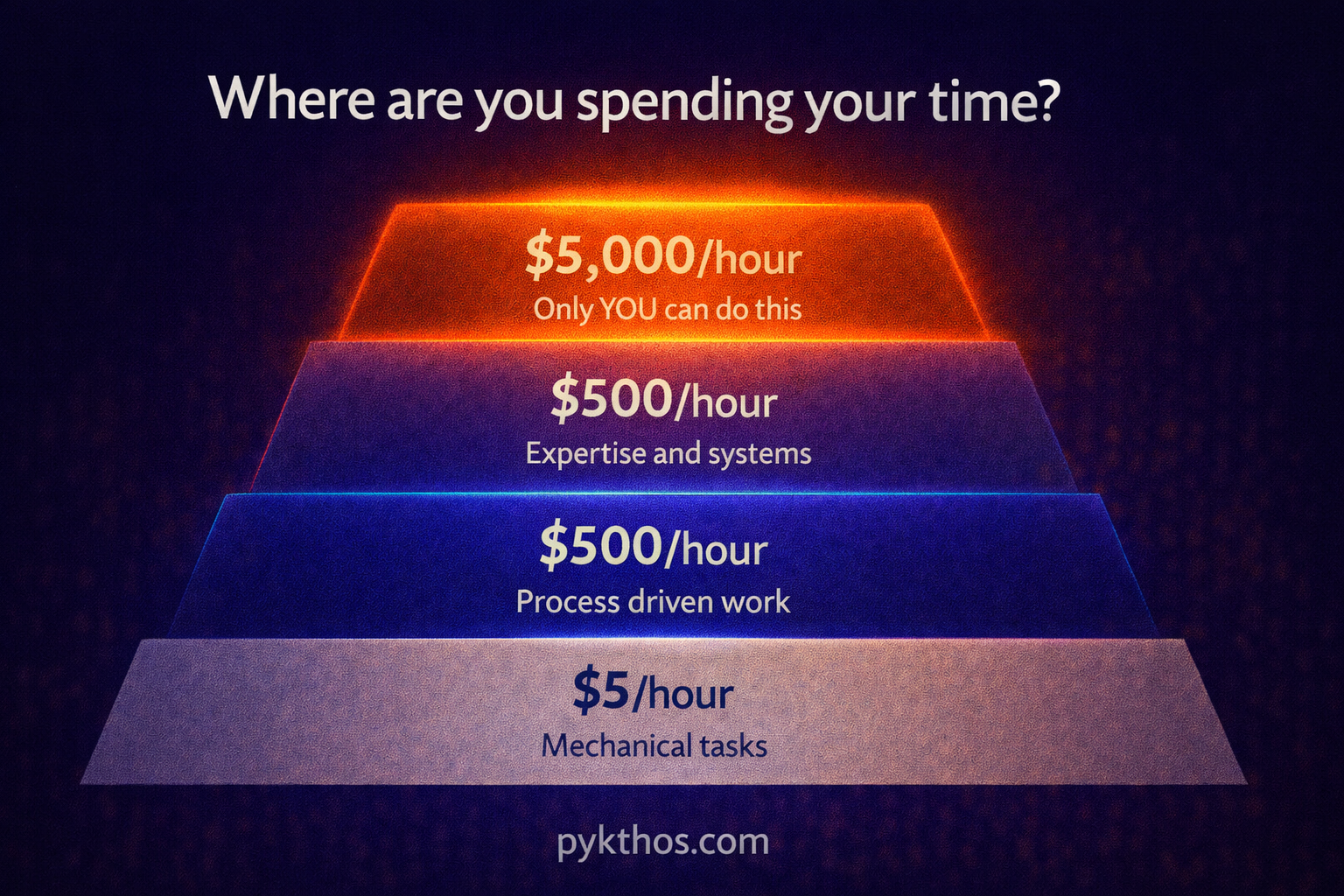
Here's the framework that Timothy taught me, and it's based on the 80/20 principle from Perry Marshall's book "80/20 Sales and Marketing."
Every task in your business falls into one of four categories:
$5/hour work - This is purely mechanical stuff. Downloading files from Zoom. Uploading videos to Google Drive. Moving files between folders. Basic data entry. Anyone could do this work with minimal training.
$50/hour work - This requires some skill but follows established processes. Writing blog post summaries. Uploading content to YouTube. Creating graphics from templates. Scheduling social media posts. It's still process-driven, but needs a bit more judgment.
$500/hour work - This is where your expertise starts to matter. Building your course content. Creating your intellectual property. Designing your service delivery systems. Training your team. This work leverages your knowledge but still follows your strategic direction.
$5,000/hour work - This is the work that ONLY you can do. Showing up for your hypnosis sessions. Teaching your signature classes. Creating new offers. Building strategic partnerships. Making key business decisions. This work directly generates revenue or creates strategic advantage.
Here's the problem: Most entrepreneurs spend 60-80% of their time doing $5 and $50 work, leaving almost no time for the $5,000 activities that actually grow their business.
I was definitely guilty of this. And I see it constantly in our community - brilliant practitioners who are exceptional at their craft but stuck in the administrative weeds.
What This Actually Looks Like
Let me give you a real example from our business.
We run multiple calls every week - Wednesday masterminds, Friday co-working sessions, and various trainings. Each call generates a Zoom recording that needs to be processed.
My original process:
Log into Zoom (manual)
Download each recording (manual)
Upload to Google Drive (manual)
Copy the transcript (manual)
Paste into ChatGPT (manual)
Request a summary (manual)
Copy summary to our shared doc (manual)
Update the team (manual)
Time per recording: 15-20 minutes
Frequency: 3-5 times per week
Total weekly time: 60-100 minutes
Annual time: 52-87 hours
That's more than two full work weeks per year spent downloading and uploading files.
Now here's what we built using an automation platform called N8N:
When a Zoom recording completes:
1. Automatically download the recording
2. Upload it to our designated Google Drive folder
3. Extract the transcript
4. Send the transcript to Claude AI for summarization
5. Save everything in a structured folder
6. Send a notification to our team
Time per recording: 0 minutes (fully automated)
We still review everything - there's always a human in the loop checking the summaries and deciding what to do with the content. But the mechanical work of moving files around? That's gone.
The Real Cost of Low-Value Work
Here's what most people don't realize: The work you're doing to "save money" is actually the most expensive decision you're making.
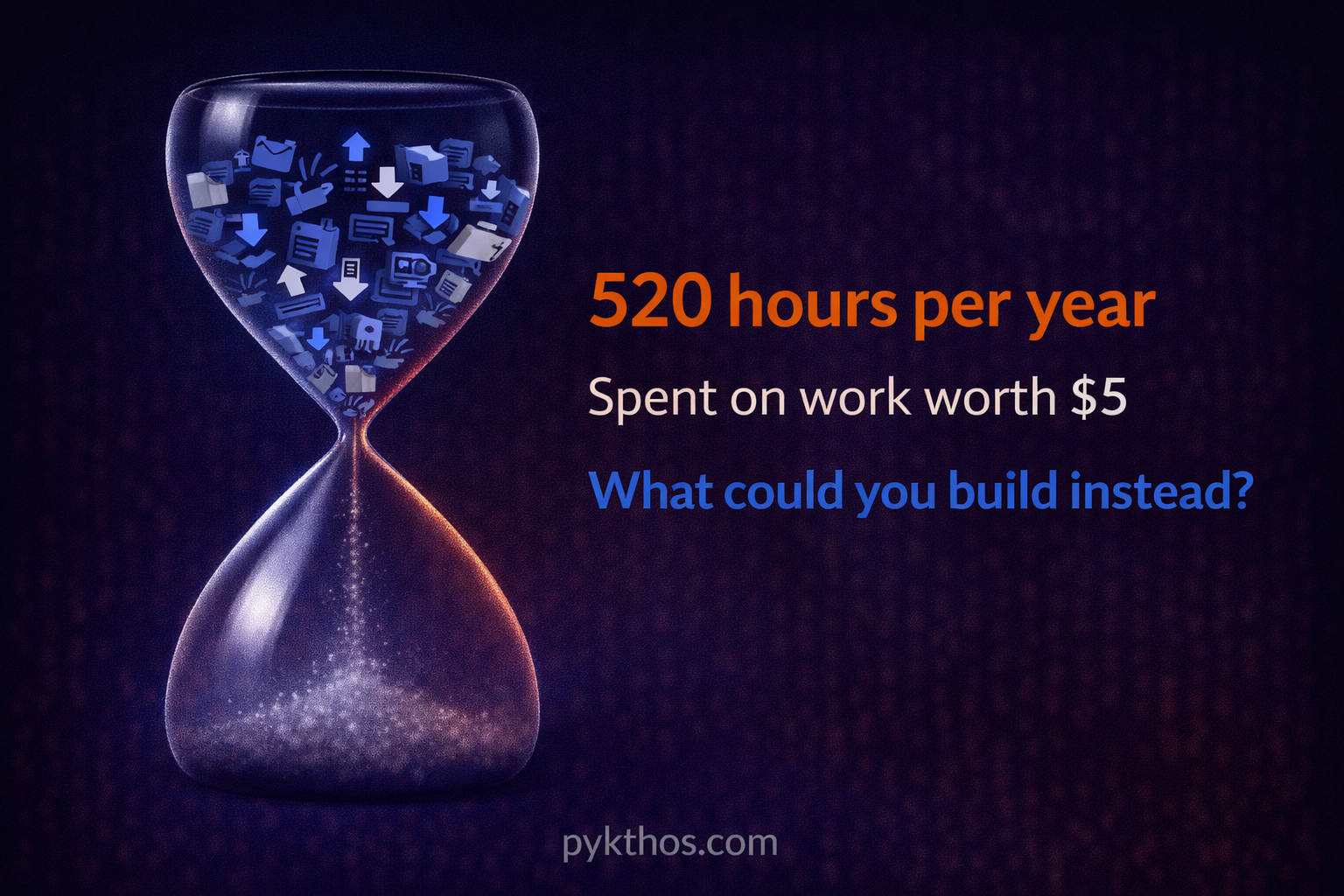
Let's say you're spending 2 hours per day on $5-$50 work. That's 10 hours per week. That's 520 hours per year.
What if you used even half of those hours on $5,000 work instead? Creating new offers. Having sales conversations. Building strategic relationships. Recording that signature training you've been putting off.
Even if we're conservative and say it's only worth $500/hour of actual value creation, that's $130,000 you're leaving on the table by doing low-value work.
But here's what makes this trap so insidious: the low-value work feels productive. You're checking things off your list. You're "getting things done." It gives you that little dopamine hit of completion.
Meanwhile, the high-value work - creating that new offer, recording that webinar, reaching out to that potential partner - sits untouched on your someday/maybe list.
The DEAL Framework for Escaping the Trap
So how do you actually escape this? You need a systematic approach.
I use a framework adapted from Tim Ferriss called DEAL:
D - Define what the task actually accomplishes. What's the end result you need?
E - Eliminate wherever possible. Do you actually need this done at all? Elon Musk says "the best part is no part" - can you design this task out of your business entirely?
A - Automate what remains. Can technology do this faster, cheaper, and more consistently than a human?
L - Liberate your time for high-value work. The goal isn't just efficiency - it's freedom to focus on what matters.
Let me be clear: Not everything needs to be automated. In fact, trying to automate everything is its own form of $50 work trap.
Here's my rule: If you're doing it 5 times a year, just do it manually. If you're doing it 5 times a week, automate it or delegate it immediately.
The sweet spot for automation:
You do it repeatedly (weekly or more)
It follows the same steps every time
It doesn't require creative judgment
It takes more than 10 minutes to complete
For everything else, consider delegation first. A virtual assistant at $15-25/hour can handle most $5 and $50 work, and you don't need to spend time building automation systems.
But I'm Not Technical - Can I Really Do This?
Here's the honest truth: I'm not a programmer. Neither is Timothy.
We learned how to build these automations by asking Claude AI to teach us, step by step. We'd hit a problem, describe it to the AI, and it would walk us through the solution.
Claude taught us about OAuth, secret keys, API calls, and how to structure data flows. Yes, we made mistakes. Yes, things broke sometimes. But the AI was patient, and it helped us troubleshoot every issue.
Timothy even built a Python script that scrapes all his Zoom recordings and downloads them automatically. He's not a Python developer - he just asked AI how to do it and followed the instructions.
That said, you don't need to become a technical expert. You have three options:
1. Learn it yourself - Use AI assistants to guide you through building automations
2. Hire someone - Pay a specialist $25-50/hour to build it for you
3. Use done-for-you systems - Platforms like Pykthos include pre-built workflows you can just activate
The key is making the decision to stop doing the low-value work yourself.

Start With One Thing
If you're feeling overwhelmed, don't try to automate everything at once.
Just pick one thing. One repetitive task that you do every week that makes you think "ugh, I have to do this again."
For me, it was downloading Zoom recordings.
For our community member Tai, it was sending webinar reminders.
For Matt, it was uploading content and writing summaries.
For April, it's delivering her lead magnet hypnosis audio.
Pick the one thing that, if automated, would give you back the most time or mental space.
Then make a decision: Will you automate it, delegate it, or eliminate it?
Just not doing it yourself anymore will free up the mental space and actual time you need to focus on the work that only you can do.
The Mindset Shift That Changes Everything
Here's what I've learned: Your job as an entrepreneur isn't to do all the work. Your job is to architect systems that do the work.
Every hour you spend downloading Zoom recordings is an hour you're not:
Creating your next offer
Recording that signature training
Having a discovery call with a potential client
Deepening a strategic relationship
Being present with your family
The low-value work will always be there, waiting to fill your day. It's comfortable. It's familiar. It feels like progress.
But it's keeping you small.
As C-level executives in our businesses, we should be doing $5,000 work. Showing up for our sessions. Teaching our classes. Building the business through ideation and strategy.
Everything from $500 down should be automated or delegated. And yes, you'll still be involved in the $500 work - training, reviewing, approving. But you shouldn't be the one executing it.
Your Next Step
Stop doing $5 work. Today.
Identify the single most time-consuming, repetitive, low-value task in your business right now. The one that makes you think "ugh, I have to do this again" every time it comes up.
Then make a decision: Will you automate it, delegate it, or eliminate it?
Just not doing it yourself anymore will free up the time you need to focus on the work that only you can do. The $5,000 work that actually builds your business.
Your future self - the one running a business that serves you instead of enslaving you - will thank you.
Interested in learning more? Check out the Pykthos Mastermind and discover how awesome it is to build a business alongside friends and colleagues who get it. https://pykthos.com/mastermind


