



Without Consumption, There Will Be No Conversion: The Customer Journey Truth Every Coach Needs to Hear
I caught myself red-handed last week doing the exact thing I tell other coaches never to do.
There I was, screen-sharing on our Wednesday mastermind call, ready to critique someone else's thank you page. I pulled up our own Strategy Cafe opt-in funnel as an example of what NOT to do. And then it hit me like a brick: we were making the exact same mistake.
The form just... disappeared. No redirect. No thank you page. Just a bland "Thanks for registering!" message where the form used to be.
If you want to know the truth about customer journeys, it's this: Most of us are screwing them up in ways we don't even realize. And it's costing us clients.
The Lauren Petrullo Principle That Changed Everything
My friend Lauren Petrullo runs Mongoose Media and handles all our ads for Mike Mandel Hypnosis. A few weeks ago, she dropped this bomb on us during a strategy call:
"If you don't get consumption, you will never get conversion."
Let that sink in for a second.
You can have the slickest opt-in page in the world. Your lead magnet could be pure gold. Your email sequences might be perfectly timed. But if nobody actually consumes what you're giving them, none of it matters.
Think about it: If someone opts in for your free audio, PDF, or video training, and they never actually open it, listen to it, or watch it... what are the odds they're going to buy from you?
Pretty much zero.
They might stay on your email list. They might even open an email six months from now that re-engages them. But you've lost momentum. You've lost that critical window of peak interest.
The Shocking Statistics Nobody Talks About
One of our mastermind members, Bradley, ran some research during our call. Want to know what the average video consumption rate is on thank you pages?
16%. One in five people.
That means 80% of the people who were interested enough to give you their email address won't watch your welcome video.
But here's the thing: that 16% who do watch? They're the easiest to convert. They're engaged. They're paying attention. They're building rapport with you.
The question is: Do you want to be average, or do you want to do better?
The Anatomy of a Broken Customer Journey
Let me show you what most of us are doing wrong, starting with our own example.
We had this opt-in page for Strategy Cafe. Clean headline, decent graphic, clear call-to-action. People would enter their name and email, click submit, and then... the form would just reload with a success message.
No personality. No next steps. No rapport building. Just: "Thanks for registering. Check your email."
This is the laziest-ass way to do things in the world.
And we were guilty of it because we launched quickly and just never went back to fix it. Randy, our developer, had set it to the default behavior. We told ourselves we'd build a proper thank you page later.
Later never came. Until we got called out for it.
What Happens When You Get It Right
Here's what we're implementing now, and what you should be doing:
1. Create an Actual Thank You Page
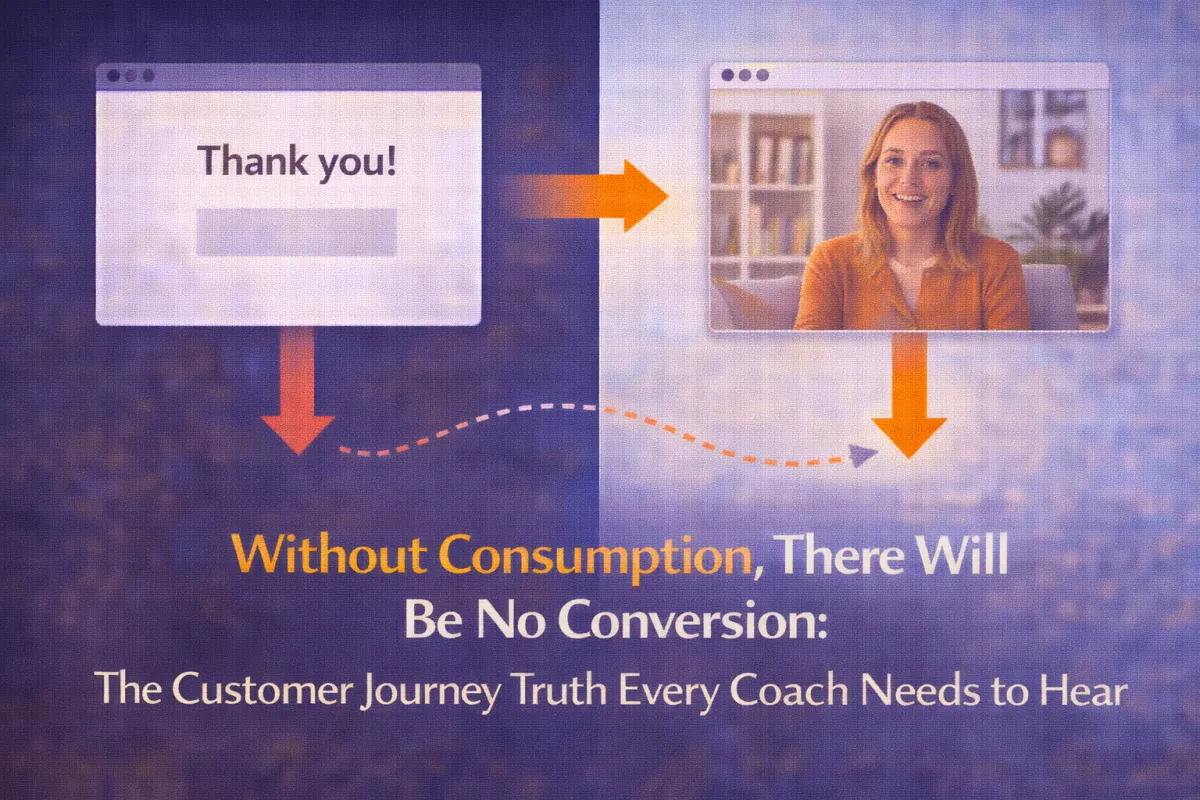
No more lazy form reloads. When someone opts in, they should land on a dedicated page that:
Builds rapport through video
Explains what happens next
Sets expectations
Opens loops that make them want to engage further
2. Put Yourself on Camera
I don't care if you think you look weird on video. Get over it.
Pull out your iPhone, stick it on a tripod, and record a 2-3 minute welcome message. Talk to them like they're your new best friend who just doesn't know it yet.
"Hey, thank you so much for registering for Strategy Cafe. I'm Chris Thompson from Pykthos, and we're really excited to have you. This is a call where we dive deep into the technical and strategic challenges you're facing in your coaching business..."
You get the idea. Be human. Be warm. Be helpful.
3. Give Them Specific Instructions
Don't just say "check your email." Tell them:
What emails they'll receive and when
What to do if they don't see the email (check spam, whitelist your address)
How to prepare for what's coming next
What action to take right now
4. Make the Next Step Obvious
Remember: You have to sell watching the video.
Your headline can't just be "Thanks for Signing Up!" That's boring. That tells people it's just a generic thank you video they can skip.
Instead, try:
"In 92 Seconds, I'll Show You [Specific Outcome]"
"Watch This Before You [Do the Next Thing]"
"Four Out of Five People Won't Watch This Video (But You're Not One of Those People, Are You?)"
Open a loop. Create curiosity. Give them a reason to click play.
The Double Bind Strategy That Works
One insight that came up during our mastermind call was the power of presupposition language.
Instead of asking IF they'll watch the video, assume they will:
"After you watch this short video, you'll understand how to [specific benefit]."
Or use a double bind:
"Would you rather download the free report now, or book a call with me to discuss your personal situation?"
Either way, they're engaging with you. Both options move them forward.
The Email Follow-Up That Increases Consumption
Here's a strategy from Lauren that's pure gold:
Send a follow-up email that links to the video on YouTube (make it unlisted if you want privacy).
Why YouTube? Because nobody thinks YouTube videos are scary or salesy. It's just... YouTube. The psychology is different.
Plus, you can track who clicks that link. Those people are showing you they're interested.
Another approach: Ask a simple question that requires only a one-word answer.
"If you could feel more of one emotion in your daily life, what would it be? Just hit reply with one word."
This does two things:
1. It starts a conversation (which warms up your email domain)
2. It gives you valuable market research
3. It creates a micro-commitment (they've engaged with you)
Lauren's philosophy: "If someone will spend 5 minutes on me, I'll spend 5 minutes back on them."
That's how you build real relationships. Not through automation, but through actual human conversation.
The Pattern Interrupt Principle
Charles, one of our mastermind members who teaches firearms training, shared something brilliant on the call.
He teaches police academies full of 18-35 year olds who are glued to their phones. His solution? He once took a student's phone, set a timer on it, and smashed it with a hammer to make a point.
Now, I'm not suggesting you destroy anyone's property. But the principle is sound:
You have 30-60 seconds to capture attention. Make them count.
Charles also noticed that his "catching a turtle" videos get millions of views, while his instructional content bombs. The lesson? Hook them with something unexpected at the beginning, then transition into the teaching.
Measuring What Matters
You can't improve what you don't measure. Here's what to track:
Opt-in rate: How many people who see your page actually opt in?
Thank you page views: Are people actually landing there?
Video play rate: How many people who land on the page actually click play?
Video completion rate: How much of the video are they watching?
Email open rates: Are they engaging with your follow-up?
Link click rates: Are they taking the next action you suggest?
Use tools like Vimeo or YouTube analytics to see these numbers. Compare them to your Google Analytics. If 100 people land on your thank you page but only 7 watch your video, you have a problem.
And that problem is costing you clients.
The Profit Process Map
Here's an exercise that will change your business:
Take a stack of Post-it notes. Map out your entire customer journey, one step at a time.
Start with: "They see my opt-in page."
Then ask: "And then what?"
"They fill out the form."
"And then what?"
"They land on the thank you page."
"And then what?"
"They watch the video."
"And then what?"
Keep going until you've mapped the entire journey from stranger to customer.
Every time you ask "and then what?", you've identified a measurement point. You've identified a place where people can drop off. You've identified an opportunity to improve.
The Bottom Line
Most coaches obsess over their opt-in rates. They split-test headlines, they tweak their lead magnets, they optimize their ad targeting.
But they completely ignore what happens after someone opts in.
That's like spending all your money on a beautiful storefront and then having a terrible experience once people walk inside.
The truth is: Getting the opt-in is just the beginning.
If you want to turn leads into clients, you need to get them to consume your content. You need to build momentum. You need to keep them engaged.
Start with your thank you page. Put yourself on video. Make it warm, human, and helpful. Give them clear next steps. Open loops that make them want to engage further.
And for the love of all that's holy, don't just have your form reload with a generic success message.
I learned that lesson the hard way. Now you don't have to.
Your Next Step
Go look at your opt-in funnels right now. Opt in to your own stuff. Experience what your potential clients experience.
Is it smooth? Is it welcoming? Does it build rapport? Does it make the next step obvious?
If not, you know what to do.
Fix your customer journey, and you'll fix your conversion rates. It's that simple.
While it may sound easy, most coaches, hypnotists, therapists, and similar “people-helpers” are GREAT at helping people overcome difficulties, but struggle when it comes to business and marketing. That’s what the Pykthos Mastermind is for. Check out: https://pykthos.com/mastermind to learn more.


