



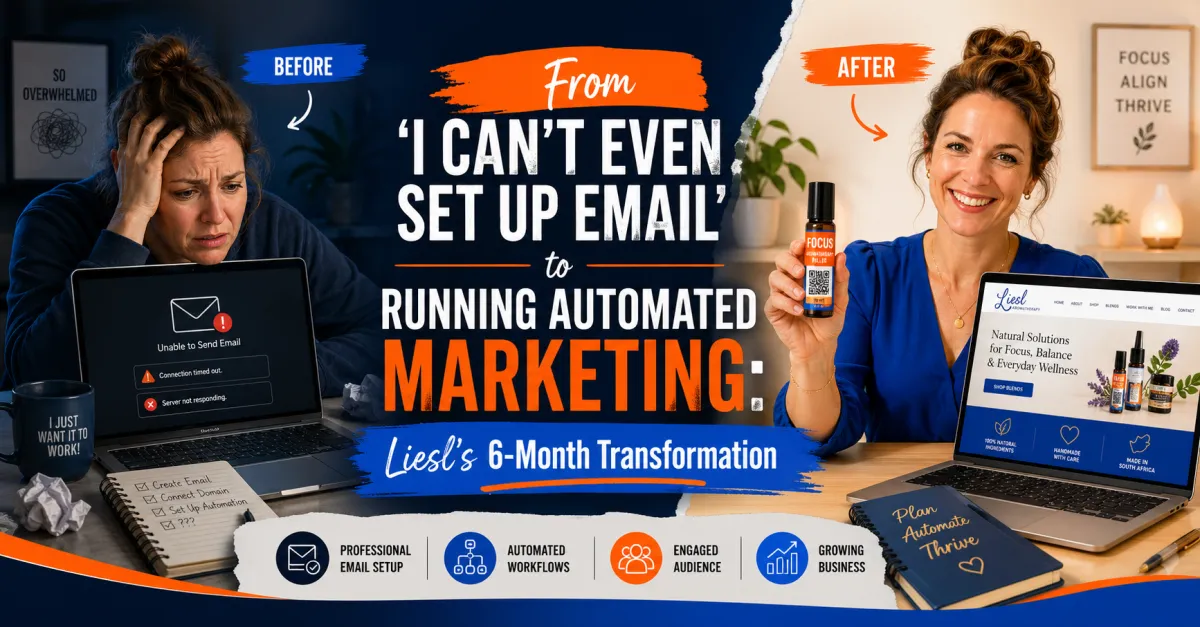
From 'I Can't Even Set Up Email' to Running Automated Marketing: Liesl's 6-Month Transformation
On our March 18th mastermind call, Liesl shared something that stopped everyone in their tracks.
"Six months ago, I couldn't even get my business email working," she said. "I spent three months trying to set up a simple business email address."
Then she held up a beautifully designed aromatherapy roller with a QR code that links to custom hypnosis tracks.
"And now I have this."
The transformation wasn't magic. It was systematic progress, one small win at a time, with the right support structure.
Let me show you exactly how she did it—because if you're feeling overwhelmed by the technical side of running an online hypnosis practice, Liesl's journey proves it's absolutely possible to figure this out.
The Starting Point: When Everything Feels Impossible
Liesl's story begins in a place many of you might recognize.
She had the skills. She had the programs designed. She had clients who got results. What she didn't have was any idea how to build the technical infrastructure to deliver and sell those programs online.
The email situation was particularly frustrating.
Three months of trying to get a business email working. Three months of following tutorials that seemed to skip crucial steps. Three months of feeling like everyone else had figured this out except her.
The problem? Her mobile carrier didn't support the notification system needed for two-factor authentication.
It wasn't a skill issue. It was a technical blocker she couldn't see.
This is a critical lesson: Sometimes you're not failing—you're just missing one piece of information.
The First Breakthrough: Finding the Right Support
What changed for Liesl was joining a community where people would actually show her which buttons to click.
Not vague advice like "just set up your DNS." Not assumptions that she already knew what SMTP meant.
Actual screen shares. Step-by-step walkthroughs. Someone saying "click here, then here, then paste this, then save."
During the call, when discussing the Mini Machine project we're building for members, Chris emphasized this exact point:
"We could also give you some video training, or PDF guides, or something that would be like, hey, here's best practices around, like, if you're gonna have a calendar with a discovery call booking page, and you want to have a video on that page, here's what we recommend you say in that video."
That level of specific guidance is what makes the difference between staying stuck and making progress.
Building the Foundation: Small Wins Compound
Once Liesl solved the email issue, momentum started building.
She tackled domains next. As she shared: "I figured out, you know, what I want to charge, starting off, and what kind of discount I want to give to friends and family, because I've had them asking. I've got two social media pages that are active."
Each small win built confidence for the next challenge.
The progression looked like this:
Week 1-4: Business email finally working:
Professional communication established
Gmail integration configured
Email signature set up
Week 5-8: Web presence established:
Domains registered and configured
Basic website launched
DNS properly set up
Week 9-12: Payment processing solved:
Discovered Stripe doesn't work in South Africa
Found local payment processor alternative
Integrated with GoHighLevel
Can now accept payments
Week 13-16: First products created:
Designed aromatherapy rollers as study aids
Created accompanying hypnosis tracks
Built landing pages for each product
Generated QR codes for seamless access
Week 17-24: Marketing automation implemented:
Welcome sequence for new subscribers
Long-term nurture sequence
Promotional sequences for specific offers
Automated follow-up after purchases
Notice the pattern? Each phase built on the previous one. You can't set up payment processing before you have a website. You can't automate marketing before you have products to market.
Sequential progress beats scattered effort every time.
The Physical Product Innovation: Where It Gets Interesting
This is where Liesl's story gets really compelling.
She had an insight: what if she created physical products that served as post-hypnotic anchors?
The aromatherapy roller isn't just a nice-smelling product. It's a trigger. When students use the peppermint and vetiver blend while studying, it activates the mental state established during hypnosis sessions.
But she wanted the integration to be seamless. No complicated instructions. No multiple logins.
Just scan the QR code on the packaging and instantly access the hypnosis tracks.
During the call, she showed us the actual product:
"This is a peppermint aromatherapy roller. My daughter did the design, and it's just beautiful. It's all matte lamination, and the packaging is just also matte lamination. It's beautiful, beautiful, beautiful."
The technical implementation required:
Product design and manufacturing coordination
Hypnosis track creation and hosting
QR code generation and linking
Landing page creation for each product variation
Email automation integration
Six months earlier, this project would have been impossible for Liesl. Now? She executed it completely.
The High-Stakes Test: Sponsoring a Business Event
Liesl didn't just create these products for her own use. She went big.
"We sponsored a very elite gathering of business people and entrepreneurs. We actually then put this in the goodie bag, and we had incredible things and wins with that, which was really, really great. So, 60 of these, which cost an arm and a leg, but anyway, it was worth the investment."
Sixty units. Professional packaging. High-end networking event.
That's not someone tentatively testing the waters. That's someone who built the confidence and capability to play at a serious level.
As Tai joked in the chat: "If it costs an arm and a leg, you just have to charge two arms and two legs."
The investment in quality paid off in brand credibility and awareness.
The Email Automation Challenge: 25 Emails Waiting to Launch
Liesl had written 25 emails for her long-term nurture sequence. They were sitting in a Google Doc, doing nothing.
She knew she needed to get them into GoHighLevel, but had no idea where to start.
This is where the community support structure proved invaluable.
During the call, Keith mentioned he had the exact same problem: "I have a 25 email sequence, and that's gonna be my next thing, I guess, to get that loaded up somehow. And to tell you the truth, I don't know where to go to put it in."
Chris immediately did a live screen share, walking through the entire process:
"Click on Marketing, then Emails, then Templates. Create a new template using the drag-and-drop editor. Set up your basic template with your logo and merge fields. Save that template."
He continued: "Then go to Automation, create new workflow, set your trigger. Add your first email action, select your template, customize the copy. Add a wait step—maybe 7 days. Copy the first email action, paste it below, rename it Email 2, and customize the content. Repeat until all 25 emails are loaded."
What seemed impossibly complex became straightforward with someone walking through it step by step.
This is exactly what Liesl experienced throughout her journey. Each technical hurdle that felt insurmountable became manageable once someone showed her the path.
The AI Accelerator: Claude Makes Everything Faster
Liesl had a breakthrough moment with AI that dramatically accelerated her progress.
As she shared on the call: "I got very cozy with Claude this weekend. Very, very cozy. And I went and wrote, like, 13 protocols."
Thirteen complete program protocols. In one weekend.
Her process: "I took pieces, and then went to go and built it, you know, like, every little piece you have that you've built, and you've thinged and did, put it in a project, and then hashed it out, and went, and it was really amazing."
She used Claude to:
Structure all her program content
Create facilitator manuals for group calls
Develop participant workbooks
Write hypnosis scripts for recording
Organize individual session protocols
Without AI assistance, those 13 protocols would have taken months. With Claude, she knocked them out in about 10 hours of focused work.
Chris's response captured what everyone was thinking: "I like your plan. Awesome. P&C approved." (We joked about making a stamp of Timothy and Chris smiling as approval.)
The Programs: What She Actually Built
Liesl didn't just build infrastructure. She built actual programs ready to deliver:
The Brain Code Study Course
Complete protocol written
Group session structure defined
Individual session framework created
Workbooks and materials prepared
Hypnosis tracks recorded
Unleash Your Creativity Program
Six-week course structure
Combines mindscaping and parts work
First session already delivered with amazing feedback
Participant materials complete
The Unstuck Protocol
Multiple variations for different applications
Can be customized for general or specific stuck points
Ready for pilot clients
During the call, she described her next 90 days: "I want to do the first cohort of each of those this quarter."
Chris gently pushed back: "That sounds like a lot. Those are megaprojects. It might be worth doing one and breaking it into three projects that all involve the technical build, the marketing aspects of the launch, and whatever else has to happen."
This is important coaching. Liesl has built the capability to execute, but the temptation is to take on too much at once.
The discipline of focus matters as much as the capability to build.
The Technical Implementation: How She Actually Did It
When Liesl described her programs, she had a critical question about implementation:
"There's just lots of little parts, and I don't know how to do any of the parts, so I'm just trying to figure out, sort of map all the little parts, and then put that together. But it's just basically, if you had a community, like, how you would then take from a call to link to a community to, you know, to add or to things to be able to send them something."
Chris gave her the simplest possible solution:
"The easiest way to do this would just be to kind of explain it all to them in a simple Google document. Just write a Google Doc that says, hey, welcome to name of program. This is how it works. On Tuesdays, we do our group call, and this is the Zoom link. You all have access to the community, here's a screenshot of what it looks like, here's the link of how to get there."
He continued: "And also, there are 8 of you in the program at a time, and everybody gets one call with me per week. Here's the booking link, where you can book yourself one call per week. I recommend you go do that now."
Timothy added the critical mindset shift: "Before you attempt to automate anything, I would just, for any of you guys who haven't, downloaded the Claude desktop app. I would just talk through exactly what you just said to us, but talk it through step by step. Because then you could just have Claude condense it down so it's in, like, a one-pager."
He emphasized: "Start mapping out, like, in your head, if you were to do this manually, no automation, no nothing, how would everyone get what they need? Because then those are all the steps that you could then automate."
Manual first, automate second.
This is the opposite of how most people approach systems. They try to automate before they understand the process. Liesl is learning to map the process first, then build the automation.
The Mindset Transformation: From 'I Can't' to 'I Haven't Yet'
The most powerful shift in Liesl's journey wasn't technical—it was psychological.
Six months ago: "I can't even set up email."
Today: "I have 13 protocols written, physical products with QR integration, multiple websites, payment processing working, and I'm ready to launch three programs."
What changed wasn't her intelligence or natural technical ability. What changed was her belief that she could figure things out.
Every technical skill feels impossible until you've done it once.
Setting up email seemed impossible until she did it. Now it's easy.
Building websites seemed impossible until she did it. Now she has multiple sites running.
Creating automation seemed impossible until she did it. Now she's building sophisticated sequences.
The skill wasn't the hard part. The belief that she could learn the skill was the hard part.
The Support Structure That Made It Possible
Liesl's transformation didn't happen in isolation. She had:
Weekly Implementation Calls
Where she could ask questions and get immediate answers
Community of Peers
People solving the same problems, sharing solutions
Screen-Sharing Sessions
Actual demonstrations of which buttons to click
AI Tools and Training
Claude for content creation, custom GPTs for specific tasks
Templates and Examples
Starting points she could modify rather than building from scratch
During the call, when discussing the Mini Machine project, Timothy emphasized this: "We wanted to open up the floor before we started overwhelming you guys with all the other cool stuff that we're doing. So when it comes to having something pre-built for you, what are some of the basic things that you guys would need?"
The community responded:
Terrence: "More custom AIs like Cassian, where it's purpose-driven. Maybe one could be, hey, tell me what I need to do next."
Terrence again: "PDFs. I love PDFs much more than video. Just because, you know, if there's an hour and a half, and you're like, somewhere in here is how to do this, that's a lot."
Daniel: "I love checklists. Step by step by step. Something where it's like a checklist, and it's like, do you have this? And if you press check, you just go to the next, but if you don't, you just click in it, and it expands to help you to create the thing."
This feedback directly shapes what gets built for members. The support structure adapts to what people actually need.
The Unsexy Wins That Matter Most
Liesl's journey included a lot of unglamorous victories:
Finally understanding what DNS means
Getting SSL certificates installed correctly
Figuring out why emails were landing in spam
Discovering her mobile carrier was blocking authentication
Finding a payment processor that works in South Africa
Learning to create custom fields in GoHighLevel
Understanding how tags and workflows connect
None of these are exciting. Nobody celebrates finally configuring DNS properly.
But these boring technical foundations are what make everything else possible.
As Chris noted when discussing project management: "Configuring payment processing isn't glamorous. But it's essential. Celebrate when you solve these boring but critical problems."
The Path Forward: What's Next for Liesl
Liesl's next 90 days focus on delivery, not building:
Project 1: Run the first cohort of Brain Code study course
Project 2: Launch Unleash Your Creativity program
Project 3: Pilot the Unstuck Protocol with initial clients
Notice these are all about using the infrastructure she built, not building more infrastructure.
She spent six months building. Now she gets to deliver.
This is the natural progression: Build the machine, then run the machine.
Too many people keep building forever and never actually launch. Liesl is making the transition from builder to deliverer.
The Lessons for Your Journey
If you're where Liesl was six months ago—overwhelmed by the technical side, not sure where to start—here's what her journey teaches:
1. Start with the smallest possible win
Don't try to build your entire marketing system on day one. Just get your business email working. Celebrate that win, then move to the next small step.
2. Find people who will show you, not just tell you
Vague advice doesn't help. You need someone who will screen share and say "click here, then here, then here."
3. Document as you learn
When you finally figure something out, write down the exact steps immediately. You'll need them again.
4. Use AI for content creation
Stop trying to write everything from scratch. Riff your ideas into Claude, let it structure them, then add your human touch.
5. Manual first, automate second
Understand the process by doing it manually. Then automate what you understand.
6. Celebrate unsexy wins
Getting DNS configured isn't glamorous. But it's essential. Acknowledge progress even when it's boring.
7. Build in public (or at least in community)
Share your wins and struggles. Others are facing the same challenges. Your breakthrough might help someone else.
The Honest Truth About Building
Liesl's journey wasn't a straight line. She shared: "It's just stupid, like, things like that, but then actually figuring, getting it to work is like, yes!"
Every simple project took longer than expected. Every technical problem revealed three more problems underneath.
But she kept showing up. Kept asking questions. Kept taking the next small step.
Six months later, she has capabilities she couldn't have imagined when she started.
You can do this too.
Not because you're particularly special or gifted with technology. But because building online infrastructure is a learnable skill, just like hypnosis was a learnable skill when you started.
You learned to guide people into trance. You learned to facilitate change. You learned to build rapport and trust.
You can learn this too.
One small win at a time.
Just like Liesl did.


