



From Drowning in DMs to Automated Freedom: How One Hypnotherapist Reclaimed 15 Hours Per Week
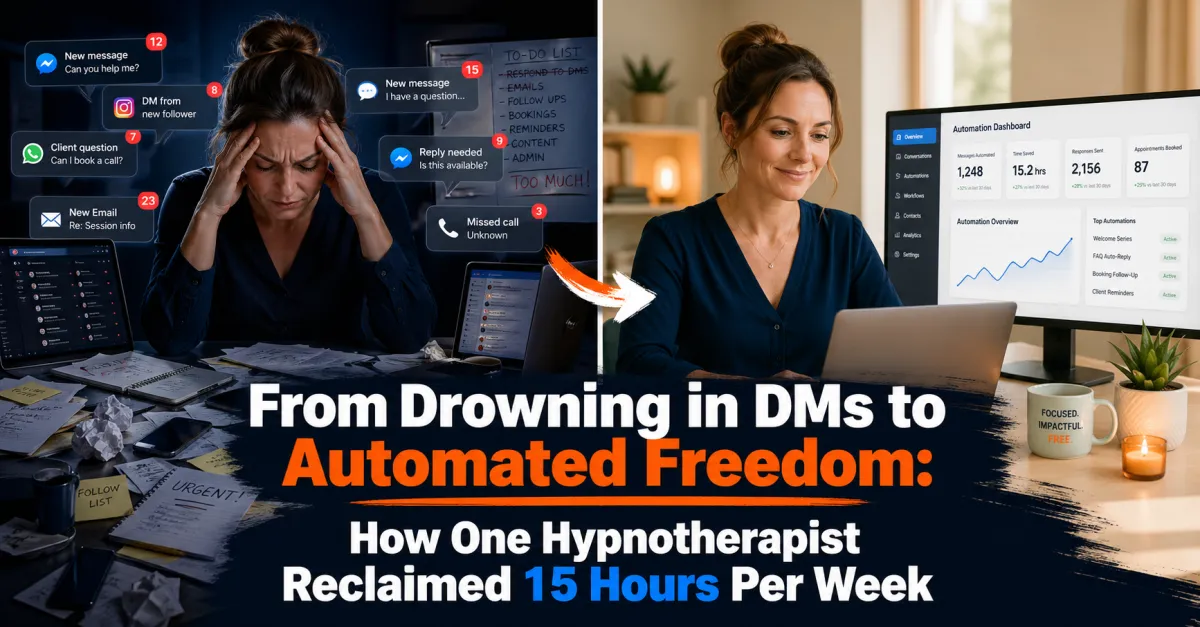
Mary was drowning.
Not literally, of course. But as she sat at her computer responding to her fifth Instagram DM of the morning—each one asking the same question, "Can I get more information on this?"—she felt the familiar weight of overwhelm settling on her shoulders.
She'd scroll through her DM inbox, reading old conversations, trying to remember: Where did I leave off with this person? Did I already ask if they've experienced hypnosis before? Should I follow up today or give them more space?
Meanwhile, her actual clients—the ones who'd already booked sessions—were getting shortchanged on her mental energy. And the videos she needed to create to attract more clients? Those were getting pushed to "tomorrow," which kept becoming "next week."
She was doing everything right, according to the marketing gurus. Running ads. Engaging with prospects. Providing value. Following up.
But it was killing her.
The Instagram Experiment Gone Wrong
Mary's ads were actually working. She was getting 5-8 DM responses per day from people interested in her $49 introductory hypnotherapy sessions.
That should have been cause for celebration. Instead, it became a second full-time job.
She tried Instagram's automated response feature. You know the one—you write a question you expect people to ask ("Can I get more information?"), and Instagram automatically replies with your pre-written answer.
It seemed perfect.
Until people started disappearing.
"The second they'd send a question and immediately see a big paragraph pop up, they'd ghost," Mary explained. "They knew they were talking to a robot at that point."
She was back to manual responses. Copy and paste became her best friend, but even then, she'd delete the generic greeting and type in each person's name, trying to maintain that human touch.
The process worked—when she could keep up. But it was exhausting, unsustainable, and worst of all, it was keeping her from the work that actually mattered.
The Cognitive Load Nobody Talks About
Here's what most business coaches don't tell you about entrepreneurship:
The hardest part isn't the actual tasks. It's the mental load of tracking everything in your head.
Which prospects are warm versus cold?
Who did I follow up with yesterday?
Which conversations are ready for the booking link?
Who needs more education before they'll buy?
Did I already send that person the intake form?
Mary was carrying all of this in her brain, constantly context-switching between clients, prospects, and the million other tasks required to run a practice.
As one practitioner in our group said, "I was in the infantry, and this might be the hardest job I've ever had." The emotional and mental tax of solo entrepreneurship is invisible but crushing.
Something had to change.
The Breakthrough: Three Simple Shifts
When Mary brought her challenge to our Pykthos Mastermind, we didn't just throw technology at the problem. We started with strategy.
Shift 1: The One-Minute Wait Step
The first fix was almost too simple. Instead of having her automation respond immediately when someone sent a DM, we added a one-minute delay.
That's it. Sixty seconds.
But that small buffer made all the difference psychologically. When the response came after a brief pause, prospects thought, Oh, okay, this could potentially be a real person.
The ghost rate dropped significantly.
Shift 2: Breaking the Big Paragraph into Smaller Bites
Mary had been sending one large paragraph that explained everything. It was overwhelming and clearly automated.
The solution? Break it into 2-3 shorter messages that get sent a minute or two apart:
Message 1: "Hey [FirstName]! Thanks so much for reaching out about the hypnotherapy session. I'd love to help you! 🙂"
[Wait 60 seconds]
Message 2: "Quick question—what were you hoping to work on? I want to make sure I can point you in the right direction."
Now it feels conversational. It feels human. And it naturally leads to engagement instead of information dumping.
Shift 3: The Open-Ended Question Strategy
Mary had been asking: "Have you experienced hypnosis before?"
That's a yes/no question. Terminal communication. Conversation killer.
We changed it to: "What was your last experience with hypnosis like?" or even better, "What made you interested in trying hypnosis?"
These open-ended questions invite stories, not one-word answers. They keep the conversation flowing and give you valuable information about how to position your offer.
The Middle Step: The Missing Link
But we identified an even bigger issue in Mary's process.
She was trying to go from "I'm interested" straight to "Give me your phone number so we can book a session."
That's too big a leap for cold Instagram prospects. They'd freeze up and ghost.
The solution? Add a middle step.
Instead of asking for a phone number, offer them something valuable with no pressure:
"You know what? I have a quick video that explains exactly how this works and what to expect. It's super helpful—let me send you the link. No pressure, just check it out and let me know if you have questions!"
That video (which could be 3-5 minutes long) does several things:
1. Educates prospects on what hypnosis actually is and isn't
2. Builds trust by letting them see and hear you
3. Filters serious prospects from tire-kickers
4. Warms them up so they're ready to book when they come back
And here's the beautiful part: this entire sequence can be automated.
The Automation That Changed Everything
Using her CRM (customer relationship management system), Mary set up what we call a "nurture sequence" for Instagram DMs:
When someone DMs:
Contact automatically created in database
Wait 60 seconds
Send personalized greeting (using merge fields for name
Wait 90 seconds
Ask open-ended question about their goals
[Human takes over here for now]
Based on response, send education video
Wait 48 hours
[Automated reminder for Mary to check in]
Follow up: "Hey! Did you get a chance to check out that video?"
Mary isn't trying to automate the entire sales conversation (yet). She's just automating the parts that don't require nuanced human judgment.
The system now:
Handles initial responses automatically
Logs every conversation
Reminds her when to follow up
Tracks where each prospect is in the journey
Eliminates the mental load of tracking everything manually
The Results: Time, Energy, and Sanity Restored
Within two weeks of implementing this system:
15 hours per week reclaimed from manual DM management
Higher conversion rate because prospects got timely, consistent responses
Zero mental load worrying about who she needed to follow up with
Better client experience once they booked, because Mary had energy for them
But the most important result?
Mary could finally focus on creating the content that attracts clients in the first place.
She wasn't spending her evenings frantically responding to DMs. She was planning videos, refining her offers, and actually doing the strategic work that grows a business.
The Lessons for Every Hypnotherapist
Mary's story isn't unique. In our Mastermind, we see this pattern constantly:
Practitioners working incredibly hard, doing all the "right" things, but drowning in the operational details instead of focusing on revenue-generating activities.
Here's what Mary's transformation teaches us:
1. Automation Doesn't Have to Be All-or-Nothing
You don't need to automate your entire sales process on day one. Start with the repetitive parts. Automate the beginning of conversations. Automate the follow-up reminders. Keep the important, nuanced parts human.
2. Small Delays Make Big Differences
Sometimes the solution isn't more technology—it's more psychology. A 60-second delay made automation feel human. Breaking messages into smaller chunks improved engagement. These aren't technical solutions; they're strategic ones.
3. The Middle Step Is Everything
Don't ask cold prospects to take big leaps. Give them a low-pressure middle step. A video. A free resource. Something that builds trust without requiring commitment.
4. Your Time Is Worth More Than You Think
If Mary's 15 hours per week had been spent on just two extra client sessions, that's $200-400 in additional weekly revenue. Over a year? $10,000-20,000.
That's the real cost of doing everything manually.
5. The Best System Is the One You'll Actually Use
Mary didn't need a complex, 47-step funnel. She needed something simple that handled the busy work so she could focus on what she does best: helping people transform.
What's Next for Mary
Mary's currently in the final two months of an internship program where she's offering $49 sessions. When that ends, she's planning to implement the complete system we've been building:
Full CRM integration
Automated discovery call scheduling
Email nurture sequences
A members area for client resources
But she's not waiting until everything is perfect. She's implementing one piece at a time, getting wins along the way, and building her machine gradually.
Your Turn: The One Thing You Can Do This Week
You don't need to overhaul your entire business this week. Just pick one repetitive task that's draining your energy.
Maybe it's DM responses like Mary.
Maybe it's appointment scheduling.
Maybe it's sending intake forms.
Maybe it's follow-up reminders.
Pick one thing and ask yourself: Could this be automated, even partially?
Then spend one hour researching how. Google it. Ask ChatGPT. Post in a community group.
One hour of research. One automation implemented. One pile of mental load removed.
That's how transformation happens—not in massive overhauls, but in small, consistent improvements.
Mary isn't drowning in DMs anymore. She's building a business that serves her instead of enslaving her.
You can do the same.
Start with one task. Start this week.
The question isn't whether you have time to automate. The question is whether you can afford not to.


