



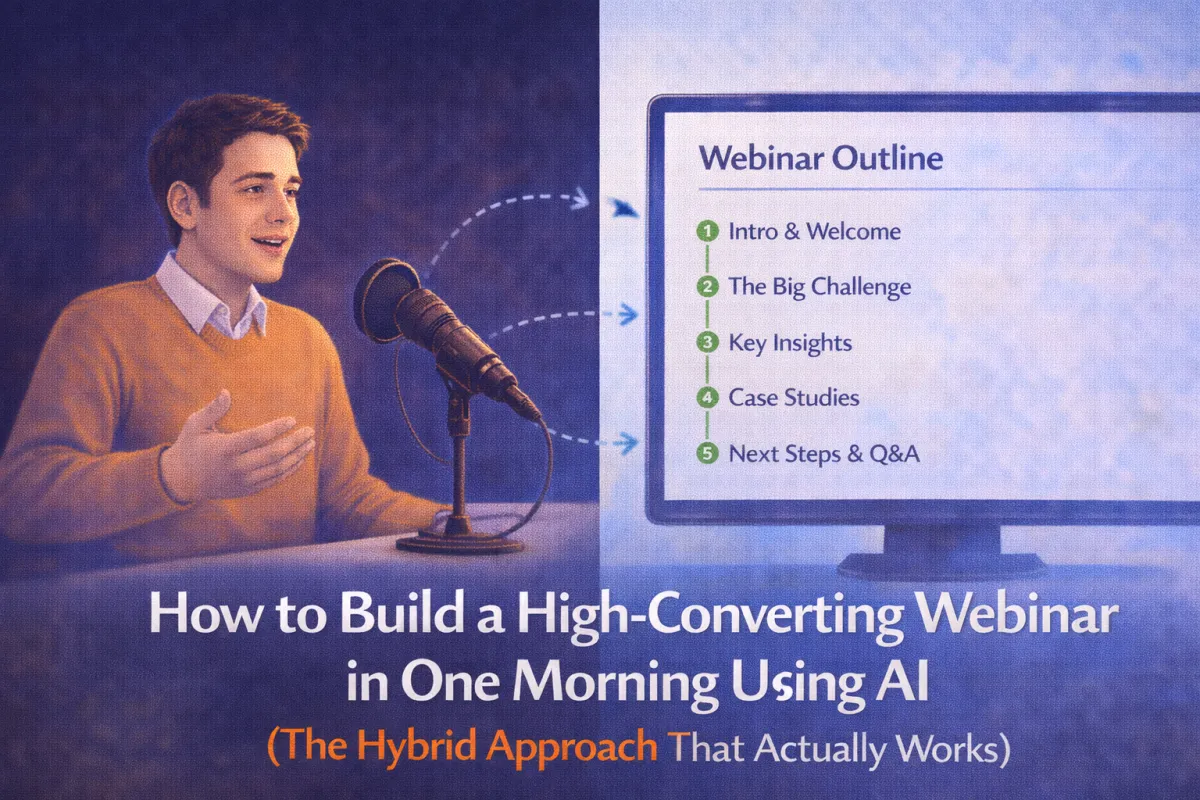
How to Build a High-Converting Webinar in One Morning Using AI (The Hybrid Approach That Actually Works)
At 8:30 this morning, I sat down with my business partner Mike with absolutely nothing prepared. By 9:15, we had a complete webinar structure, teaching framework, and strategic direction that would have taken us days—maybe weeks—to develop the old way.
What made the difference? A hybrid approach I call "riffing with intelligence."
This isn't about letting AI do all the work. It's not about prompting once and hoping for magic. This is about understanding how to dance with AI—how to bring your expertise and let artificial intelligence amplify it into something extraordinary.
The Problem with Traditional Webinar Planning
Here's what usually happens when you decide to create a sales webinar:
You sit down with a blank document. You stare at it. You write some ideas. You second-guess yourself. You research what others are doing. You get overwhelmed by all the moving pieces—the hook, the teaching content, the transition to the offer, the bonus stack, the close.
Three weeks later, you're still "working on it."
Meanwhile, leads are coming in, opportunities are passing by, and that webinar you know would convert stays locked in planning purgatory.
Sound familiar?
The Breakthrough: Stop Writing, Start Riffing
The game-changer is understanding that AI doesn't need a perfect prompt. It needs a conversation.
I learned this from my friend Mercer, who calls it "riffing." I used to call it "ranting," but his term sounds less angry and more creative. The concept is simple: just talk.
Here's what I did this morning:
I put on my Meta AI sunglasses (you can use any Bluetooth device), opened Otter.ai, and just started talking. I told my AI assistant Atlas—a custom GPT I've trained on my business context—exactly what we were trying to do.
My opening riff went like this:
"Hey Atlas, I'm here with Mike. We're on Zoom, and we're talking to you. Well, I'm talking to you, and we're discussing the teaching portion of what will ultimately be a sales webinar. We want to start doing monthly live webinars to sell lifetime access to MMHA. We're not worried about the sales portion of the webinar yet. We're going to deal with that in another chat, but for now..."
I spoke for maybe 30-40 seconds. No script. No perfect phrasing. Just raw thinking out loud.
The Magic of "Highly Likely to Be Most Obviously Useful"
Here's a linguistic trick Mercer taught me that completely changed my AI interactions:
Instead of giving rigid instructions like "create a 5-part structure with these exact elements," I ask AI to give me what is "highly likely to be the most obviously useful experience."
This phrasing does something brilliant. It puts constraints on the AI to focus only on what's genuinely useful, but it doesn't create fake limitations that restrict creative thinking.
When I asked Atlas to extract the "hidden nuggets of gold" from our previous training recording, I didn't tell it how to structure the response. I just asked for what would be most obviously useful.
The result?
It immediately identified:
The core emotional win participants needed
Why doing a live demo would be crucial
The exact teaching framework (broken into 5 clear steps)
Specific moments from our original presentation that stood out as "gold"
How to structure the teaching without overwhelming beginners
The Deep Research Amplifier
Here's where the hybrid approach gets really powerful.
After several rounds of back-and-forth with my AI, refining the webinar structure and adding my own insights, I reached a point where I needed a broader perspective. That's when I borrowed a strategy from my colleague Timothy.
I asked Atlas: "I want you to give me a prompt to create a deep research report that will be highly likely to be the most obviously useful output for the webinar development."
Atlas generated a comprehensive prompt designed specifically for deep research. This wasn't a generic "research webinars" prompt. It was tailored to:
Our specific audience (beginners and poorly-trained hypnosis practitioners)
Our teaching style (the Mandel Method)
Our psychological approach (building confidence, not just teaching technique)
The exact outcome we wanted (people understanding they can actually do this)
I then did something clever:
I copied that exact prompt and ran it through BOTH ChatGPT's deep research AND Claude's deep research. Why both? Because different AI models have different strengths, and I wanted the most comprehensive perspective possible.
Eight minutes later, I had two extensive research reports.
Bringing It All Together
Here's where most people stop. They get the research and think, "Great, now I have to read all this and figure out what to do with it."
Not me.
I took both research reports and fed them BACK into my original conversation with Atlas. I simply said: "I got ChatGPT and Claude to both run that prompt. I'm attaching the reports here. Are they useful?"
Atlas evaluated both reports, told me what was strong about each one, what was missing, and how to combine the best insights from both.
Then it asked me clarifying questions:
"Is this too academic for your audience?"
"Do you want Mike's personal style to come through more?"
"Should we include more stories or focus on technique?"
I answered those questions in natural conversation, and Atlas refined the structure again.
The Final Output: Copy-Paste Ready
After about 15 more minutes of refinement, I had everything I needed. But there was one problem: the formatting was a mess of emojis, hard line breaks, and weird spacing that would look terrible in a Google Doc.
So I asked for one final thing: "Create a Google Doc and give me fenced markdown of the entire structure."
Atlas generated clean, formatted markdown that I could paste directly into Google Docs with proper headings, spacing, and structure. No cleanup needed.
Total time investment: About 90 minutes of actual work (most of which was just me talking), plus the time for AI to generate the research reports while I was out shopping with my kids.
What I ended up with:
Complete webinar teaching structure
Specific content recommendations
Psychological framework for the presentation
Ideas for visual aids and graphics
Strategic guidance on how much to teach vs. how much to sell
A document I could hand to Mike saying, "Here, add your stories and examples"
The Broader Application
Here's what excites me most: this same process works for ANYTHING.
Need to create a course curriculum? Riff about your ideas, get deep research on adult learning principles, refine with AI.
Planning a year of social media content? Riff about your expertise, research content trends, let AI structure the calendar.
Building an onboarding sequence? Riff about user experience, research SaaS best practices, create the flow.
We used this exact approach earlier this week to redesign the entire onboarding experience for our platform. The concept of "quests" (gamified onboarding steps) came from a riffing session at Target while my kids were in the fitting room.
The Key Principles That Make This Work
1. Start with Conversation, Not Perfection
Your first interaction with AI should be messy, human, and full of your actual thinking process. Don't try to write the perfect prompt. Just talk.
2. Use Context-Aware AI
Create custom GPTs or Gems that already know your business, your style, and your goals. My Atlas assistant knows all my projects, team members, and business contexts. That saves enormous amounts of explanation time.
3. Iterate, Don't Generate
This isn't about prompting once and getting a final product. It's about multiple rounds of refinement where you bring your expertise and judgment to guide the AI.
4. Leverage Multiple AI Models
Different AIs have different strengths. ChatGPT might excel at structure, Claude at writing quality, Gemini at understanding documents. Use them all.
5. Feed Research Back Into Conversation
Deep research is powerful, but it's most powerful when you bring those insights back into your working conversation and ask, "How does this change our approach?"
The Skills You Need to Develop
This hybrid approach requires you to get better at two things:
First, learn to think out loud effectively. Not every thought needs to be polished. In fact, the messy, exploratory thinking is often exactly what AI needs to understand your real intent.
Second, learn to evaluate AI output critically. When Atlas gave me the initial structure, I didn't just accept it. I pushed back: "Is this too light on teaching? Will people feel like they got real value?" That pushback made the final product significantly better.
Why This Matters Now
We're still in the early adopter phase of AI. Reports suggest only about 5% of people are using it effectively for work.
This is the dotcom moment of our era.
Those who learn to leverage AI effectively now—not as a replacement for their expertise, but as an amplifier of it—will move faster, create better, and achieve more than seemed possible just a year ago.
Those who don't? They'll be like our parents were with the internet, watching from the sidelines wondering what happened.
Your Next Steps
Start riffing today. Pick one project you've been stuck on. Open a voice recorder or Otter.ai. Just talk about it for five minutes. What are you trying to achieve? Who is it for? What makes you excited about it?
Then take that transcript and feed it to ChatGPT, Claude, or Gemini with this simple prompt: "I'm working on [project]. Here's me thinking out loud about it. What are the most important insights you notice, and what should I focus on next?"
See what happens.
Then iterate. Ask follow-up questions. Request a deep research report on the most critical aspects. Bring that research back into the conversation.
The goal isn't to let AI do your work. The goal is to move from weeks of planning to hours of creation, from overwhelming complexity to clear action, from stuck to shipping.
That's the power of the hybrid approach.
And it's available to you right now.
Ready to dive deeper into these kinds of topics and more? That’s what the Pykthos Mastermind is for. Learn more: https://pykthos.com/mastermind


