




The Real Secret to Scaling Your Hypnosis Practice: Why Conversations Beat Algorithms Every Time
I watched something remarkable happen during our Wednesday Pykthos Mastermind call. One of our members, Tai, asked the question that every hypnotist, coach, and practitioner wrestles with: "How do I get more clients?"
His story was familiar. Four clients so far. All from organic connections—free sessions, referrals, in-person interactions, maybe some social media awareness. He couldn't quite track where they came from. Sound familiar?
Then he asked the million-dollar question: "How do I scale this?"
And that's when Chris Thompson dropped a truth bomb that changed the entire conversation.
The Momentum Problem We're All Ignoring
Here's what nobody talks about when they're teaching you social media marketing: your customers aren't on the platform to look at your stuff.
They're on the platform to scroll their feeds. Their momentum, their hetero action, is entirely focused on content that concerns them personally. Think about your own behavior for a second.
How many times have you scrolled through Instagram or Facebook, seen something interesting, and immediately clicked "buy"?
Never. Nobody does that.
What actually happens is this: scroll, scroll, scroll, "oh that looks cool," save it, remember it, email yourself the link, go find reviews, check if the person is real, read testimonials, compare options, research alternatives... and THEN maybe, possibly, eventually buy.
Why Your Social Media Strategy Is Probably Wrong
Here's the pattern I see constantly: practitioners think they need to pitch on social media. They create content, build a following, and then wonder when the right time is to start asking for the sale.
But that's not how social media works in 2026.
Chris explained it perfectly during our call: "I wouldn't even necessarily do that on social at all, really. We don't post too much stuff telling people to join MMHA. We have ads that do that, but our social stuff usually is just giving value in some way."
The call to action isn't "buy my services." The call to action is "let's have a conversation."
Your job on social media is twofold:
Get people aware that you exist
Engage them in a way that starts a conversation
That's it. That's the whole strategy.
The Conversation Economy
When Tai asked how to scale conversations, he was asking the right question—he just needed to reframe what "scale" meant.
Instead of trying to scale something you haven't mastered yet, do it manually until it becomes something you can either delegate or automate. Get good at having conversations first. Understand what resonates. Learn what your ideal clients actually need to hear.
Because here's the thing about conversations: they break the scroll momentum.
When someone moves from scrolling Instagram to sending you a DM or text message, they've switched mental circuitry. They're no longer in passive consumption mode. They're in active engagement mode. That's when transformation happens. That's when sales happen.

The Lead Magnet Sweet Spot
During the call, we discussed how lead magnets fit into this strategy. A lead magnet isn't about capturing email addresses to blast people with sales messages. It's about creating another conversation entry point.
When someone opts in for your free resource, they're saying: "Yes, I want to know more about what you do." That's an invitation to start a conversation.
The beauty of this approach? You can measure it. You can track it. You can see what resonates.
One member shared their insight: "I need a working positive ROAS funnel filling my calendar with qualified clients. I want more clients!"
But before you can have a positive return on ad spend, you need to know what messages actually resonate with your audience.
The Problem Statement Strategy
Here's a tactical approach we shared during the call that you can implement immediately:
Take your perfect client profile and ask AI this question: "What are 10 problem statements using Eugene Schwartz's levels of awareness that my client has, as if you are the expert marketer?"
Then reverse it: "Now you're the customer. What are the problem statements that you actually might have about this?"
Now you have 20 problem statements from two different perspectives.
Post one per day for 20 days on social media. Just put it out there. "Does this resonate with you? If you're looking for more peace in your life..." and share the problem statement.
See what resonates. See what people interact with. See if anybody comments. Track it manually.
You're not selling. You're not pitching. You're starting conversations based on real problems your ideal clients actually have.
The Traffic Store Is Open
As Chris said on the call, and I love this line from Ryan Deiss: "There's no traffic problem. You can just go to the traffic store."
With AI running behind the scenes on platforms like Meta and Google, audience targeting is easier than ever. You don't need to be magical at pushing buttons. You just need the right message.
If you're willing to buy traffic, scaling conversations becomes significantly easier. But—and this is crucial—you need to nail the message first.
Test your problem statements organically. See what gets responses. Then amplify what works with paid traffic.
The Bamboo Growth Metaphor
I shared this metaphor on the call because it perfectly captures what building a practice actually feels like:
Bamboo takes five years to grow. For five full years, it travels deep underground, building an extensive root structure. The farmer waters the ground daily while everyone around them thinks they're crazy.
"I swear I planted bamboo here! It's going to grow, I promise!"
But nobody sees anything.
Then, after that fifth year, in about 90 days, bamboo shoots out of the ground and grows 16, 20, even 30 feet high.
That's running a business. It might not seem like progress. It might take weeks, months, even years. But one day, you're going to have fruit that nobody else around you saw coming.
Except you. Because you knew. You kept watering the ground. You kept having conversations. You kept showing up.
What Actually Works Right Now
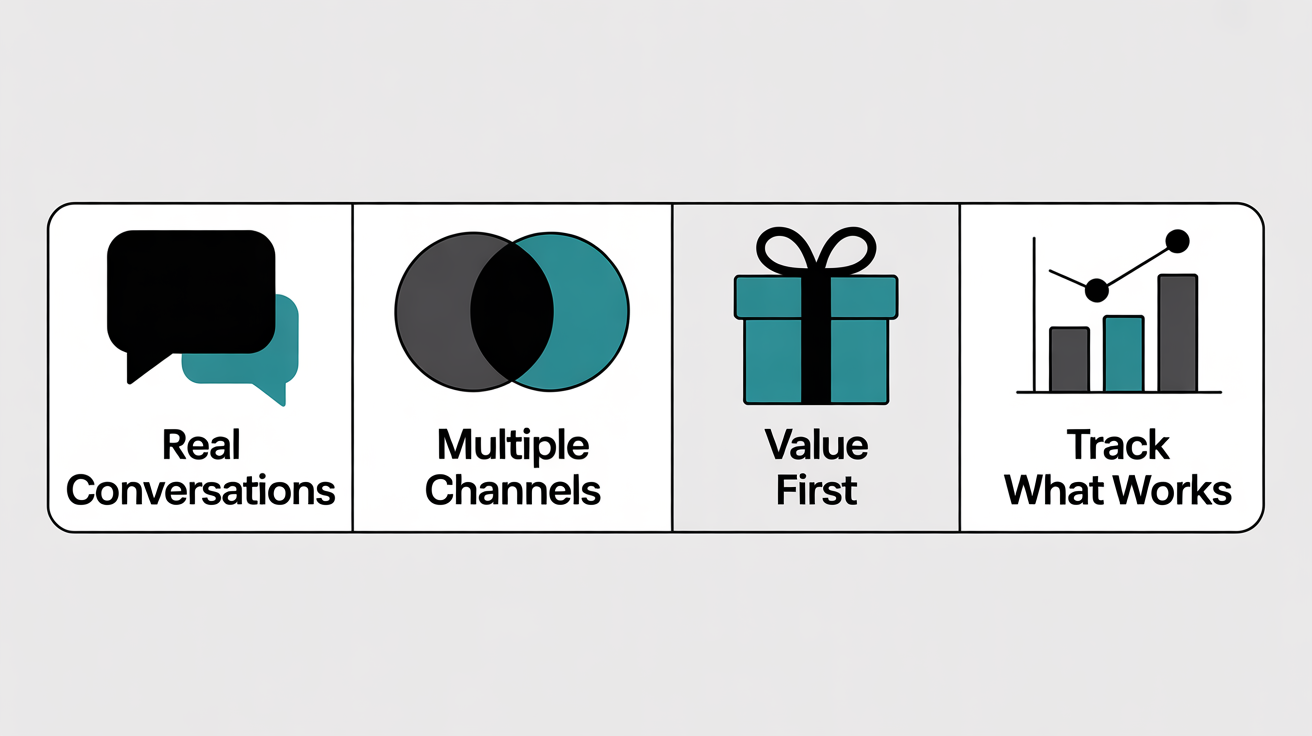
Let me synthesize what we learned from multiple practitioners on the call who are getting real results:
They're having conversations. Not broadcasting. Not pitching. Having genuine human-to-human conversations about real problems.
They're using multiple channels. Social media, yes. But also in-person meetups, coffee shop conversations, referrals, email, text messages, DMs.
They're providing value first. Free sessions for veterans. Group hypnosis events. Educational content. Problem-focused social posts.
They're tracking what works. Even if it's manual. Even if it's just a spreadsheet. They're paying attention to where clients actually come from.
Your Next Steps
If you want to scale your practice, stop thinking about algorithms and start thinking about conversations.
Here's your action plan:
1. Audit your current client acquisition. Where did your last 5 clients come from? What was the conversation that led to the sale?
2. Create 20 problem statements. Use AI to help you articulate what your ideal clients are actually struggling with.
3. Post one problem statement daily. Track engagement. See what resonates. Have conversations with people who respond.
4. Make conversation easy. Put a clear call to action on every piece of content: "DM me if this resonates" or "Reply if you want to talk about this."
5. Break the scroll. Get people off the platform and into direct communication with you—email, text, phone, Zoom.
The practitioners who are winning right now aren't the ones with the most followers. They're the ones having the most conversations.
So stop optimizing for likes and start optimizing for dialogue.
Because at the end of the day, you don't build a practice on viral posts. You build it one conversation at a time.
Ready to stop chasing algorithms and start having real conversations with ideal clients? Join our Pykthos Mastermind community where we help practitioners build sustainable, conversation-driven practices. https://pykthos.com/mastermind


