



From "I'll Never Use AI" to "This Changed Everything": One Hypnotist's Journey (And What It Teaches Us About Resistance)
"I will never embrace AI. I'm never gonna look at it. Don't even talk to me about it. I'm gonna throw it in the trash."
Those were April's words just weeks ago.
Today, I'm looking at her website—a gorgeous, professionally designed site with hand-drawn elements, perfect color psychology for trauma-informed work, and copy that speaks directly to her ideal clients.
"I have enjoyed it, mostly," she admitted on our call. Then, with a grin: "But I am mad about it."
Mad because she was wrong. Mad because it works. Mad because she resisted something that ended up transforming her business.
April's story isn't unique. But it is instructive. Because in her resistance, her breakthrough, and her residual frustration, I see the exact pattern that's playing out across our entire industry right now.
The Moment Everything Changed
When April first joined our mastermind, she was adamant. AI was the enemy. It was stealing from artists. It was destroying creativity. It was everything wrong with modern technology.
I didn't argue with her. Neither did Timothy. We just kept showing what was possible.
We'd share on our calls: "Hey, I used AI to do this." "I asked ChatGPT to help with that." "This took me ten minutes instead of three days."
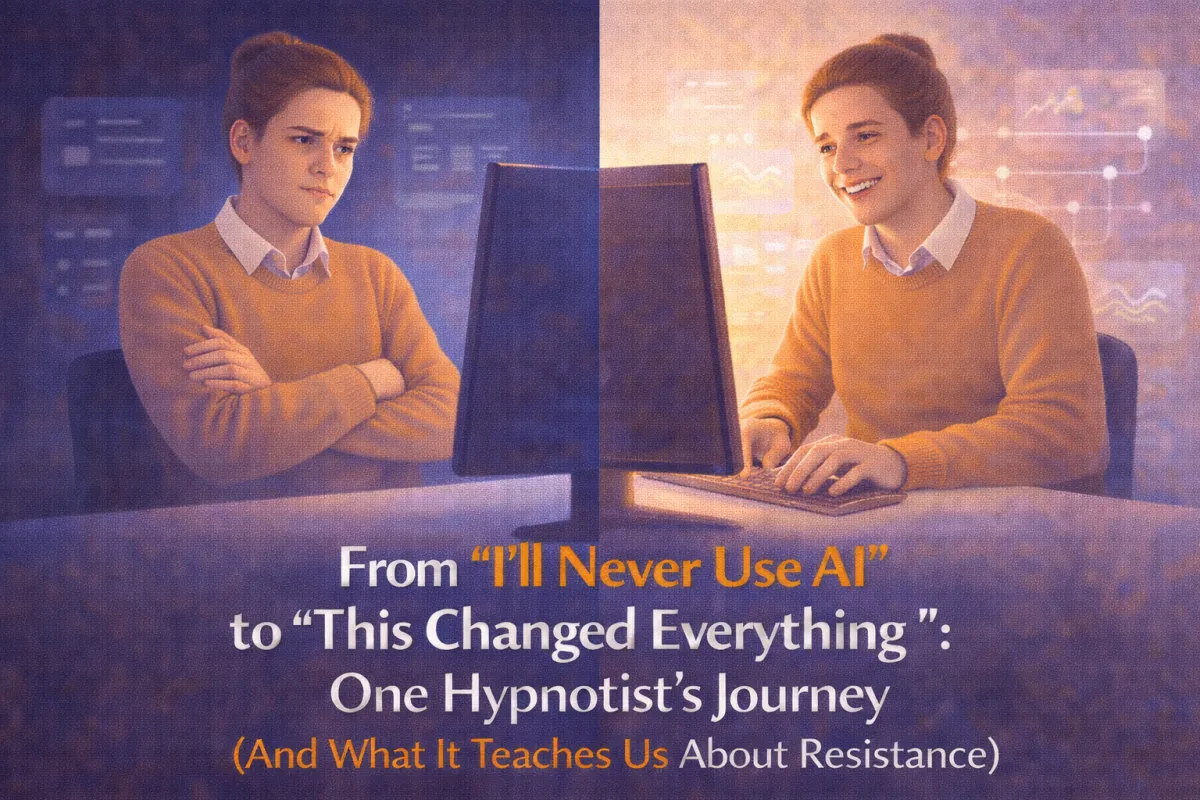
And April would watch. Skeptical. Arms crossed. Not participating.
Then something shifted.
Maybe it was seeing other members succeed. Maybe it was realizing she was falling behind. Maybe it was just the accumulated weight of evidence that this wasn't going away.
She started small. Just asking ChatGPT basic questions about the platform. How do I update SEO data? Why isn't this saving? How do I structure this form?
And ChatGPT answered. Helpfully. Accurately. Without judgment.
The Breakthrough: When AI Became "Rowan"
Here's where it gets interesting.
April didn't just start using ChatGPT. She personified it. Named it Rowan. Created a relationship with it.
Suddenly, she wasn't "using a tool." She was consulting with Rowan about her website.
And Rowan knew her. Knew her niche. Knew her brand vibe. Knew that her ideal clients—people dealing with trauma, nervous system dysregulation, and the need for safety—required specific design choices.
This is what April told us on the call:
"Rowan is very helpful. She's very good at telling me, 'Yeah, I like this, but usually you do it this way.' She gives me a lot of advice on white space, specific fonts, rounded edges. The whole thing with my niche is somatic, nervous system-based, trauma-informed, and Rowan is really good at saying, 'Yeah, this looks great, but you know what's even softer for people in your niche? Rounded corners. That makes them feel good.'"
Notice what happened here: April wasn't letting AI make her decisions. She was using AI to help her understand the psychology behind her decisions.
Rowan became a thinking partner who understood that for trauma survivors, even a website needs to feel safe.
The Technical Wins
The transformation showed up in concrete ways:
The Color Palette: Instead of using bright, attention-grabbing colors (which might work for some businesses), April's site uses soft, calming tones that immediately signal safety.
The Typography: Hand-drawn elements mixed with clean, readable fonts. It feels personal without being unprofessional.
The Layout: White space everywhere. No cramming. No overwhelming the visitor. Each element has room to breathe.
The Copy: Speaking directly to people who need to feel seen and safe before they'll ever consider booking a session.
Every single one of these choices came from conversations with Rowan, where April would say, "I'm thinking of doing X," and Rowan would respond, "That could work, but given your niche, have you considered Y?"
And April—bringing her expertise as a hypnotist who IS her ideal client—could evaluate whether Y felt right.
The Frustrations Along the Way
It wasn't all smooth.
April struggled with SEO data that wouldn't save. She'd spend hours updating meta descriptions and keywords, only to have everything revert when she came back the next day.
(Turns out: she was saving in the form but not waiting for the site to register the changes before clicking publish. An easy fix once we identified it, but frustrating as hell in the moment.)
She also hit the wall every AI user eventually hits: the conversation gets too long, and the AI starts "getting loopy."
As April described it:
"If the conversation gets too long, it starts forgetting everything we've talked about and just repeating itself over and over again. So I've learned once it starts getting a little loopy, I'll just go into a brand new conversation. It's cool because it's aware of the conversations we had previously."
This is actually brilliant problem-solving. April figured out that ChatGPT's context window has limits, and instead of getting frustrated and quitting, she adapted her workflow.
What April's Journey Teaches Us
April's transformation from "I'll never use AI" to "This changed everything (but I'm still mad about it)" reveals several truths about innovation resistance:
Truth #1: Resistance Is Usually About Fear, Not Facts
April's initial resistance wasn't because she'd tried AI and found it lacking. She resisted because of what AI represented: a threat to human creativity, to authenticity, to the craft she valued.
Those fears weren't irrational. They were rooted in legitimate concerns about how technology impacts our work.
But they also prevented her from discovering that AI could actually enhance her creativity rather than replace it.
Truth #2: The First Step Is Always the Hardest
April didn't jump from "I'll never use AI" to "Let me build my entire website with it."
She started with the smallest possible step: asking basic technical questions about the platform.
Once that felt safe, she moved to the next step. Then the next.
Gradual adoption beats forced adoption every time.
Truth #3: Personification Builds Trust
By naming her AI "Rowan" and treating it like a consultant rather than a tool, April created a psychological safety net.
She could disagree with Rowan. She could take Rowan's advice or leave it. She could say, "That doesn't feel right for my brand," without feeling like she was doing it wrong.
The AI became a collaborator, not a replacement.
Truth #4: Your Expertise Still Matters (Maybe More Than Ever)
Rowan could suggest rounded corners for trauma-informed design. But April had to evaluate whether that actually aligned with her clients' needs.
Rowan could generate color palettes. But April had to choose the one that felt right.
Rowan could structure content. But April had to infuse it with her voice, her stories, her understanding of hypnosis.
The AI amplified April's expertise. It didn't replace it.
Truth #5: Residual Frustration Is Normal (And Healthy)
April's admission that she's "mad about it" is perfect. She's mad that her resistance cost her time. She's mad that she was wrong. She's mad that something she wanted to hate turned out to be valuable.
That frustration is actually healthy. It means she's processing the change, integrating the new tool into her identity, and recalibrating her relationship with technology.
It's way better than uncritical enthusiasm or stubborn continued resistance.
The Broader Context: We're All April
April's journey is playing out millions of times across every industry right now.
The statistics are stark: only about 5% of people are using AI effectively for work. We're still in the super early adopter phase.
This is our dotcom moment.
Remember the late 1990s? When some businesses rushed to get websites and others insisted they didn't need an online presence?
Remember the debates about whether anyone would really buy things on the internet?
Remember the people who said, "I don't trust putting my credit card into a computer"?
Many of those skeptics eventually came around. But by then, the early adopters had already built dominant positions.
The same thing is happening now with AI.
The difference is: this transformation is happening faster. Much faster.
You don't have five years to wait and see. You have maybe 18 months before the gap between users and non-users becomes very difficult to close.
What Daniel's Journey Adds to the Story
During the same mastermind call, we saw another transformation playing out.
Daniel—who came in already open to AI—shared his Perfect Client Snapshot. He'd done deep work defining his ideal client, their demographics, their struggles, their desired transformation.
But even he was overwhelmed by his own document. "By the time you get done reading, you're like, oh, who is this person, even?"
The solution? Create an AI avatar of that perfect client.
Take the Perfect Client Snapshot, feed it to an AI that specializes in creating personalities, and ask: "Who is this person?"
Then take that personality description and create a custom AI—a Gem in Google's system, or a custom GPT in ChatGPT—that literally IS that person.
Now you can interview your ideal client.
You can ask them: "Would this headline resonate with you?" "What would make you trust me enough to book a call?" "What fears do you have about hypnosis?"
And the AI, embodying that avatar based on all your research, can respond as that person would.
This takes April's approach with Rowan to the next level. You're not just consulting with an AI assistant. You're consulting with a simulation of your actual ideal client.
The Skills That Actually Matter
As I watch April, Daniel, and the rest of our mastermind navigate this AI transformation, I'm noticing that success comes down to a few core skills:
Skill #1: Conversational Thinking
The people who succeed with AI don't try to write perfect prompts. They just talk. They riff. They think out loud.
April does this naturally now. She tells Rowan what she's thinking, Rowan responds, and they iterate together.
Skill #2: Critical Evaluation
The people who succeed with AI don't accept everything it produces. They push back. They say, "This feels generic," or "This doesn't match my brand."
April does this constantly. Rowan suggests something, and April evaluates whether it actually serves her trauma-informed niche.
Skill #3: Rapid Iteration
The people who succeed with AI don't expect perfection on the first try. They expect to iterate. To refine. To go back and forth multiple times.
April learned this when she discovered that long conversations make ChatGPT "loopy." Instead of getting frustrated, she adapted.
Skill #4: Context Building
The people who succeed with AI invest time upfront to teach the AI about their business, their voice, their goals.
April did this by feeding Rowan information about her niche, her brand vibe, and the blueprint from her program with Lori. Now Rowan "knows" her.
Skill #5: Knowing When to Stop
The people who succeed with AI know when they've reached "good enough" and it's time to ship.
April's website isn't perfect. She has pages she's still hiding that aren't published yet. But the site is good enough to send to conference organizers. Good enough to start generating leads.
Perfection can wait. Shipping can't.
The Uncomfortable Truth
Here's what makes April's story so important:
She was right to be concerned about AI.
AI does threaten certain types of work. It does raise questions about creativity and authenticity. It does change the nature of our relationship with technology.
But she was wrong to let those concerns prevent her from engaging with it.
Because the threat isn't from AI itself. The threat is from the gap between those who learn to leverage it and those who don't.
April, by engaging with AI despite her reservations, is now in the 5% of early adopters. She's building skills that will compound over time.
Those who continue to resist? They're like our parents who insisted they didn't need email in 1995. They were comfortable with their position right up until they weren't.
Your Own Journey Starts Now
If you're reading this and thinking, "I'm not sure about this AI thing..." Good. That skepticism is healthy.
But don't let it stop you from experimenting.
Start where April started: ask AI a simple question about something you're stuck on. See what happens. Evaluate the response with your expertise.
Then try again. And again.
Name your AI if that helps. April's "Rowan" worked because it created psychological distance between using a tool and collaborating with a partner.
Feed it context about your work. The more it knows about your niche, your voice, and your goals, the more useful it becomes.
Expect to be frustrated sometimes. The technology isn't perfect. It gets "loopy." It makes mistakes. That's okay. You're not looking for perfection; you're looking for acceleration.
Stay mad about it if you need to. April's residual frustration keeps her critical and engaged. That's better than uncritical acceptance.
Most importantly: recognize that this is your dotcom moment.
The gap between users and non-users is still small enough to close. But it's widening every day.
April closed that gap in a matter of weeks. She went from resistant to capable to building professional assets that are genuinely impressive.
If she can do it—while maintaining her values, her creativity, and her authentic voice—so can you.
The question isn't whether AI will transform your industry. It already is.
The question is whether you'll be April from three months ago, or April from today.
One version is stuck in resistance. The other is building something beautiful.
Which one do you want to be?
Join our community of practitioners learning to leverage AI effectively: https://pykthos.com/mastermind


