



From Facebook Groups to Paying Clients: The Ethical Way to Turn Community Engagement Into Revenue
One of our mastermind members asked me a question that I know many of you are wondering: "How do I go from commenting in Facebook groups to getting those people to follow me and eventually buy from me?"
It's a great question. And the answer requires walking a very fine line between being helpful and being a spammy jerk.
Let me share the strategy that works—and the mistakes that will get you banned.
The Facebook Group Goldmine (And Why Most People Waste It)
Facebook groups are incredible for one specific reason: they get your ideal audience to publicly discuss their problems without you having to ask them directly.
Think about it. In what other context do people voluntarily share their deepest frustrations, questions, and pain points with a room full of strangers?
This is market research on steroids. And it's free.
But here's where most people go wrong: they think the value is in selling directly in the group. It's not.
The value is in understanding your audience's language, problems, and objections—then creating content that addresses exactly those issues.
The Strategy That Works (Without Getting You Banned)
Here's the complete process, step by step:
Step 1: Join Relevant Groups and Observe
Don't post immediately. Spend a week or two just reading.
Look for:
Questions that come up repeatedly
Specific language people use to describe their problems
Objections or concerns people express
Solutions people have tried that didn't work
Save these as a document. You're building a content library.
One of our members mentioned she's been pasting every comment she leaves in groups into a document. That's brilliant. You're capturing the exact language that resonates with your audience.
Step 2: Create Content That Answers Those Questions
Now take those problem statements and turn them into content on YOUR platform.
Examples:
Someone says they wake up at 2 AM and scroll their phone because they can't get back to sleep
You create a blog post, video, or social media post addressing that exact issue
You give genuine, valuable advice with no strings attached
This content lives on YOUR Facebook page, YOUR YouTube channel, YOUR blog—not in the group.
Step 3: The Comment That Builds Bridges
Now go back to that Facebook group post and leave a comment like this:
"Hey [Name], I actually just dealt with this exact issue myself. Here's what I'd suggest: [give a small piece of value in the comment]. But there's way too much to cover in just this comment—it really needs a deeper dive. I actually made a video/post that walks through the complete solution. I don't want to promote myself here, but if you're interested, I'm happy to DM you the link or you can DM me."
Let's break down why this works:
You're giving value first in the comment itself. You're not saying "DM me" with nothing to show.
You're being respectful of the group rules by not posting promotional links.
You're putting the ball in their court. They have to reach out to you.
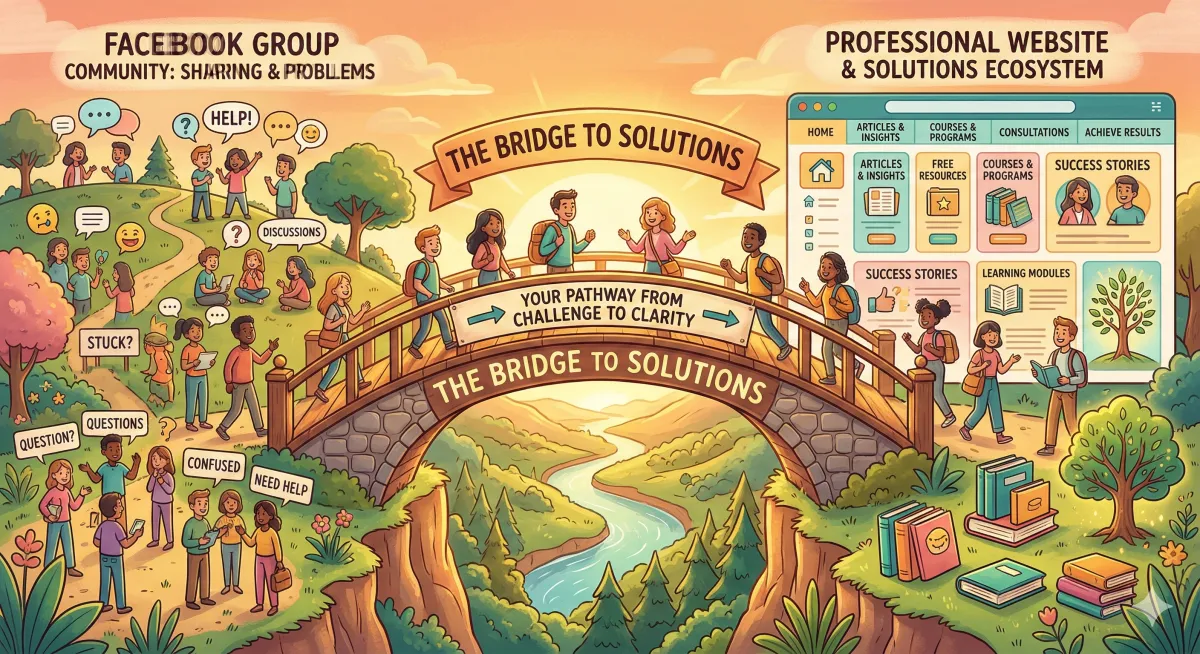
You're creating a bridge from the group to your own content ecosystem.
Step 4: When They DM You, Send Them Into Your Ecosystem
When someone reaches out and asks for the link, NOW you can send them to your content.
They initiated the conversation. You're not soliciting. You're responding to a direct request.
This is where you send them to:
Your YouTube video
Your blog post
Your Facebook page post
Your podcast episode
Not to a sales page. Not to a calendar booking link. To VALUE.
Step 5: Once They're in Your Ecosystem, You Can Sell
Here's the magic: once someone is engaging with your content OUTSIDE the Facebook group, they're fair game for sales conversations.
If they comment on your YouTube video or Facebook post, you can absolutely DM them and say:
"Hey, I noticed you watched my video on [topic]. I'm glad it was helpful! I actually work with people one-on-one on exactly this issue. If you'd like to chat about whether that might be a fit, I'd be happy to set up a time."
This is ethical. This is allowed. This works.
The Critical Warning: What Will Get You Banned
I need to be very clear about what NOT to do, because we've had to ban people from our own communities for crossing these lines.
Don't Directly Pitch in DMs
Scenario that gets you banned:
Someone asks a question in a Facebook group. You DM them saying "I can help with this! Let's hop on a call." On the call, you immediately pitch your coaching program.
You've now poached someone from a community, used their vulnerability against them, and violated the trust of the group.
Don't Post Links Publicly
Scenario that gets you banned:
You drop your calendar link or website in the comments of someone's post. Even if you're genuinely trying to help, this looks like spam and will get you removed.
Don't Pretend to Help While Pitching
Scenario that gets you banned:
You offer help, provide some legitimate value, but then immediately transition into a pitch without being asked.
The key is: let them come to you for the next step.
Why This Ethical Approach Actually Works Better
You might be thinking: "This seems like a lot of extra steps. Why not just pitch directly?"
Here's why the ethical approach is actually more effective:
1. You're pre-qualifying prospects
Someone who takes the initiative to DM you and engage with your content is far more likely to buy than someone you cold-pitch.
2. You're building genuine authority
When you consistently show up with valuable content, people start seeing you as the expert. They want to work with you.
3. You're not burning bridges
You stay in good standing with group admins and members. You might even become known as the helpful person who always has great advice.
4. You're creating assets
Every piece of content you create for this strategy can be used again and again. It's not a one-time pitch—it's a reusable resource.
Special Considerations for Vulnerable Audiences
One of our members is working with women struggling with fertility issues. This is a particularly vulnerable audience, and the ethical considerations are even more important.
When working with vulnerable populations:
Be extra careful about not taking advantage of people in pain
Provide MORE value upfront before ever mentioning your services
Make sure your solutions are evidence-based and realistic
Never create false hope or promise outcomes you can't guarantee
The rule of thumb: If you'd be uncomfortable with someone treating YOUR loved one this way in a vulnerable moment, don't do it.
The Content Repurposing Strategy
Here's a bonus strategy that makes this even more efficient:
When you create a piece of content based on a Facebook group question, you can use that SAME content to answer similar questions in multiple groups.
The process:
1. See a question in Group A about insomnia
2. Create a comprehensive video/post about insomnia solutions
3. Answer the original question in Group A with a helpful comment + offer to share your longer resource
4. When you see the SAME question in Groups B, C, and D, use the same approach
5. You've now used one piece of content to build bridges with people across multiple communities
This is why documenting the questions you see is so valuable. You start to notice patterns, and you can create content that addresses multiple iterations of the same core problem.
The Platform Comparison: Facebook vs. Other Communities
While we're focusing on Facebook groups here, this strategy works in other communities too:
Reddit: Similar approach, but even stricter about self-promotion. Focus heavily on providing value in comments, be very subtle about offering additional resources.
LinkedIn: Actually more permissive. You can share links to your content more freely, but the same principle applies—value first, selling second.
Discord/Slack communities: Often have specific channels for self-promotion. Follow the rules precisely, but the same bridge-building approach works.
Online forums: Depends heavily on the specific forum rules, but the ethical framework remains the same.
The Long-Term Community Building Play
Here's what happens when you execute this strategy consistently over 3-6 months:
Month 1: You're relatively unknown. You're mostly observing and creating content.
Month 2: People start recognizing your name. "Oh yeah, that's the person who always has helpful advice about [topic]."
Month 3: Group members start tagging you when questions come up in your area of expertise.
Month 4-6: You've become a trusted authority. People seek you out. Some group admins even invite you to do guest trainings or workshops.
This is the ultimate outcome: You're no longer hunting for clients. They're coming to you.
What to Do When Group Admins Are Watching
Some Facebook groups have very active admins who watch for any hint of self-promotion. Here's how to navigate that:
Be abundantly transparent:
"I have a resource that goes deeper into this, but I don't want to break any group rules. If you're interested, feel free to DM me and I can share it privately."
Follow the posting guidelines religiously:
Many groups have specific days or threads for sharing resources. Use those appropriately.
Build a relationship with admins:
Engage genuinely in the community first. Then, if appropriate, reach out to admins to ask if there's a way you could provide value (like a free workshop or training) to the group.
Never argue with admins:
If you get called out for something that felt borderline, apologize and adjust. It's not worth burning the bridge.
Your Action Plan for This Week
Day 1-2: Research Phase
Join 3-5 Facebook groups where your ideal clients hang out
Spend 30 minutes per day just reading posts
Document 10 questions or problems people are discussing
Day 3-4: Content Creation Phase
Choose the 2-3 most common problems from your list
Create content addressing those problems (video, blog post, or social media post)
Make sure each piece provides genuine, actionable value
Day 5-7: Engagement Phase
Find posts in groups that relate to your content
Leave helpful comments with a small piece of value
Offer to share your more comprehensive resource via DM
Respond promptly when people reach out
Ongoing:
Continue documenting questions you see
Create new content regularly
Build genuine relationships in communities
Track which content resonates most
The Mindset Shift That Changes Everything
Here's the fundamental shift you need to make:
Stop thinking: "How can I sell to these people?"
Start thinking: "How can I be so helpful that these people want to work with me?"
When you show up consistently with genuine value, when you respect community guidelines, when you let people come to you instead of chasing them—you're not just building a business. You're building a reputation.
And reputation is the most valuable asset you can have.
The Results Speak for Themselves
When we ran our recent lifetime membership promotion, we got 50+ qualified responses from a simple email to our warm audience.
These weren't cold leads. These were people who'd been consuming our content, engaging with our community, and building a relationship with us over time.
That's the power of doing this right.
You're not tricking people. You're not manipulating them. You're genuinely helping them, and when they're ready to invest in a solution, you're the obvious choice.
So get out there, find your communities, and start building those bridges—the ethical way.
And if you'd love help with this or have any other questions, that's what the Pykthos Mastermind is for.
Check it out at https://pykthos.com/mastermind


