




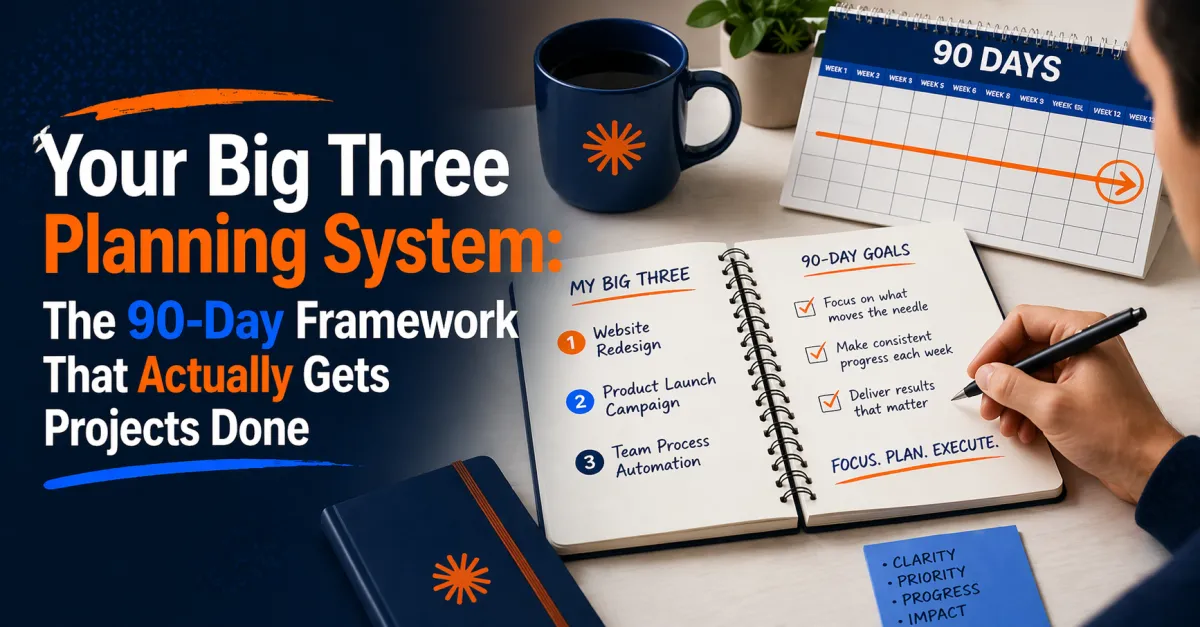
Your Big Three Planning System: The 90-Day Framework That Actually Gets Projects Done
How many projects are you working on right now?
If you're like most entrepreneurs I know, you probably just mentally counted somewhere between seven and fifteen active initiatives. Maybe more.
Here's the uncomfortable truth: You're not going to finish most of them.
Not because you're lazy or incompetent. But because human beings simply cannot maintain meaningful progress on that many fronts simultaneously.
Let me introduce you to the system that changed everything for our business: The Big Three.
Why 90 Days Is the Perfect Planning Window
Before we dive into the mechanics, you need to understand why 90 days matters.
A year feels overwhelming. When you set annual goals, your brain doesn't register urgency until October. By then, you've wasted 10 months of potential progress.
A month feels frantic. Thirty days isn't enough time to complete substantial projects, so you end up focusing on quick wins that don't move the needle.
But 90 days hits the sweet spot.
It's long enough to accomplish something significant—building an email sequence, launching a program, creating a complete marketing funnel. Yet it's short enough that the deadline feels real from day one.
Every project we've ever estimated would take "just a couple weeks" has taken way longer. Timothy and I joke about this constantly. We'll think something is a quick build, and three months later, we're still refining it.
But we've also experienced the opposite. Projects we thought would take forever sometimes come together overnight when we have focused intention and the right 90-day container.
The Big Three Framework: How It Works
Here's the entire system in one sentence:
Every 90 days, you choose up to three major projects that will move your business forward, and you work on nothing else of significance.
Notice I said "up to three." In PYKTHOS, we currently have only two projects this quarter. Even though it's called the Big Three, we're eating our own cooking and proving that sometimes two is the magic number.
The framework forces brutal prioritization. You can't hide behind busy work. You can't scatter your energy across a dozen initiatives. You must choose what matters most.
The Four Categories: Where Projects Come From
Not all projects are created equal. Before you start randomly selecting what to work on, you need to understand the four categories of business growth:
Acquisition
These are projects focused on getting people into your awareness circle. Building a lead magnet. Creating a social media presence. Launching a podcast. Running ads.
Acquisition projects answer one question: How do strangers discover you exist?
Activation
These projects turn subscribers into customers. Building a discovery call funnel. Creating your first paid offer. Developing an email sequence that leads to sales.
Activation projects answer: How do leads become buyers?
Monetization
These are the big revenue drivers. Launching a high-ticket program. Creating a course. Building out a membership offering.
Monetization projects answer: How do I make most of my money?
Retention
These keep customers coming back. Building a community. Creating ongoing support systems. Developing advanced offers for existing clients.
Retention projects answer: How do I keep customers engaged and buying more?
When you categorize your project ideas this way, patterns emerge. You might realize you're spending all your energy on acquisition but you have no activation system. Or you've built a great front-end offer but nothing for monetization.
The categories help you see where the actual holes in your business exist.
The Profit Process Map: Your Foundation
Before you can intelligently choose your Big Three, you need one critical tool: your Profit Process Map.
This is the visual representation of how customers flow through your business. It might look like:
1. Lead magnet opt-in page
2. Thank you page
3. Short-term engagement email sequence (delivers the lead magnet)
4. Indoctrination campaign (welcomes them to your world)
5. Booking funnel (gets them to schedule a call)
6. Discovery call
7. Long-term nurture sequence (stays in touch with those not ready to buy)
When you map this out visually, you can see exactly where people are falling off.
Maybe 100 people visit your opt-in page but only 5 subscribe. That's an acquisition problem—your messaging isn't resonating.
Or maybe 50 people subscribe but zero book calls. That's an activation problem—you're not creating enough urgency or demonstrating enough value.
Your Profit Process Map tells you what projects to prioritize.
The Profit Tracker: Measure What Matters
Here's where most people fail: they don't measure anything, so they have no idea what's actually working.
Your Profit Tracker is dead simple. It's a spreadsheet with:
Week 1 metrics (days 1-7 of the month)
Week 2 metrics (days 8-14)
Week 3 metrics (days 15-21)
Week 4 metrics (days 22-28)
Remainder days (29-31)
Month actual (what really happened)
Month target (what you hoped would happen)
Status (on target, catching up, behind, off target, missed the mark)
You don't need to track 47 different metrics. In fact, you probably need fewer than 10.
For most hypnosis practices, here's what matters:
Homepage metrics:
How many people visited?
How many opted in?
Discovery call metrics:
How many people landed on the calendar page?
How many booked?
How many showed up?
How many opened reminder emails?
Sales metrics:
How many people landed on your order form?
How many bought?
How many consumed what they bought?
Those nine metrics tell you everything you need to know about whether your business is growing or dying.
And here's the beautiful part: it takes less than 10 minutes per week to track them.
Just create a simple Google Sheet, open your analytics once a week, and input the numbers. That's it.
If you can backfill data from previous months, even better. Then you have a baseline to compare against.
The ICE Ranking System: Prioritizing Your Big Three
You've got your Profit Process Map showing where the holes are. You've got your Profit Tracker showing what's actually happening. Now you need to choose which projects to tackle.
This is where ICE ranking comes in:
Impact: How much will this project move the needle if it works? (1-10 scale)
Confidence: How confident are you that you can execute this successfully? (1-10 scale)
Ease: How easy is this project to implement relative to others? (1-10 scale)
Multiply those three scores together, and you get your ICE rank.
Example: Building an email nurture sequence
Impact: 8 (email is proven to convert)
Confidence: 7 (you've written emails before)
Ease: 6 (takes time but it's straightforward)
ICE Score: 336
Example: Creating a complex multi-tier membership program
Impact: 9 (could generate significant revenue)
Confidence: 4 (you've never built anything like this)
Ease: 2 (requires tech setup, pricing strategy, content creation, community management)
ICE Score: 72
The email sequence wins, even though the membership has higher potential impact. Why? Because you're far more likely to actually complete it and see results.
The best project is the one you'll actually finish.
Real Examples: What Big Three Projects Look Like
Let me share what people are actually working on:
Michelle's Big Three:
1. Getting her LLC established and business bank account opened
2. Building and launching her website with booking capabilities
3. Creating her initial service offerings and pricing structure
Notice these are all foundation projects. Michelle is hanging her shingle. She's not worried about advanced monetization yet—she's focused on acquisition infrastructure.
Daniel's Big Three:
1. Recording and producing his first audio products (modular approach)
2. Building landing pages and website to serve those products
3. Creating outreach systems (press kit, podcast appearances, local business connections)
Daniel is in launch mode. Everything is aimed at getting his work into the world and in front of people.
Terrence's Big Three:
1. Website optimization (converting better, analytics implementation)
2. Consistent video production (two shorts per week, one long-form hypnosis session)
3. Exploring advertising once the foundation is solid
Terrence has infrastructure built. Now he's optimizing and scaling what works.
PYKTHOS Big Three (our actual projects):
1. Building the "Mini Machine" snapshot for members (complete funnel template)
2. Delivering that asset with training and support systems
We literally have two projects this quarter. That's it. Because we know those two projects are actually massive when you break them into sub-projects.
Breaking Down Big Projects Into Manageable Chunks
Here's the secret: your Big Three aren't really three projects. They're three umbrellas containing multiple sub-projects.
Take our Mini Machine project:
Sub-project 1: Build the technical snapshot in GoHighLevel
Create opt-in page template
Create thank-you page template
Build short-term engagement email sequence
Build indoctrination campaign
Build long-term nurture sequence
Set up all automation and tagging
Test the entire flow
Sub-project 2: Create supporting training materials
Write step-by-step PDF guides
Record implementation walkthrough videos
Build custom GPT to answer member questions
Create troubleshooting documentation
Sub-project 3: Package and deliver to members
Create delivery mechanism
Write announcement email
Schedule implementation support calls
Gather feedback and iterate
See how one "project" actually contains a dozen smaller projects?
That's why three is the magic number. You're not really limiting yourself to three things—you're focusing on three major initiatives that each contain meaningful work.
The Weekly Review: Staying on Track
Here's how you actually execute your Big Three:
Every Monday morning:
Review your Profit Tracker from last week
Look at your Big Three projects
Choose 2-3 sub-tasks from those projects to complete this week
Block time on your calendar specifically for those tasks
Every Friday afternoon:
Update your Profit Tracker with this week's numbers
Review what you accomplished toward your Big Three
Adjust next week's focus based on what you learned
That's the entire system. Monday planning, Friday review, stay focused on your Big Three all week.
Common Big Three Mistakes to Avoid
Mistake #1: Choosing projects that are too small
If you can complete a "project" in two days, it's not a Big Three project. It's a task. Your Big Three should take weeks or months to fully execute.
Mistake #2: Choosing projects that are too vague
"Improve my marketing" isn't a project. "Build an email nurture sequence with 12 emails that leads subscribers to book discovery calls" is a project.
Mistake #3: Not measuring whether projects worked
You built the thing. Great. Did it move the needle? Check your Profit Tracker. If website visits went up after your SEO project, it worked. If they didn't, it failed. Measure outcomes, not just completion.
Mistake #4: Trying to work on everything at once
This is the hardest discipline. You WILL have other ideas. You WILL see shiny objects. Write them down in your ICE ranking system, then get back to your Big Three.
Mistake #5: Not carrying over incomplete projects
If you don't finish something this quarter, that's okay. Carry it over to next quarter's Big Three. Don't abandon it just because you hit a 90-day boundary.
The Commitment: Why This Works
The Big Three works because of one simple psychological principle:
You can't hide from three things.
When you have 15 active projects, you can always convince yourself you're making progress somewhere. Even if nothing significant is moving forward, you can point to activity.
With three projects, there's nowhere to hide. Either you're moving forward on your priorities, or you're not.
That uncomfortable clarity is exactly what drives results.
Your Next 90 Days: Getting Started
Step 1: Map your current customer journey (Profit Process Map)
Step 2: Identify the biggest holes or opportunities
Step 3: Brainstorm possible projects, categorized by Acquisition, Activation, Monetization, or Retention
Step 4: ICE rank your top 5-10 project ideas
Step 5: Choose your Big Three based on:
What will move the needle most?
What can you realistically complete in 90 days?
What do your metrics say needs attention?
Step 6: Break each Big Three project into sub-projects and tasks
Step 7: Start working, track weekly, review and adjust
That's it. That's the system that has helped us build multiple six-figure businesses and guided hundreds of PYKTHOS members to meaningful progress.
Ninety days from now, you'll either have three completed projects that moved your business forward, or you'll have a dozen unfinished initiatives that went nowhere.
Your choice.


